
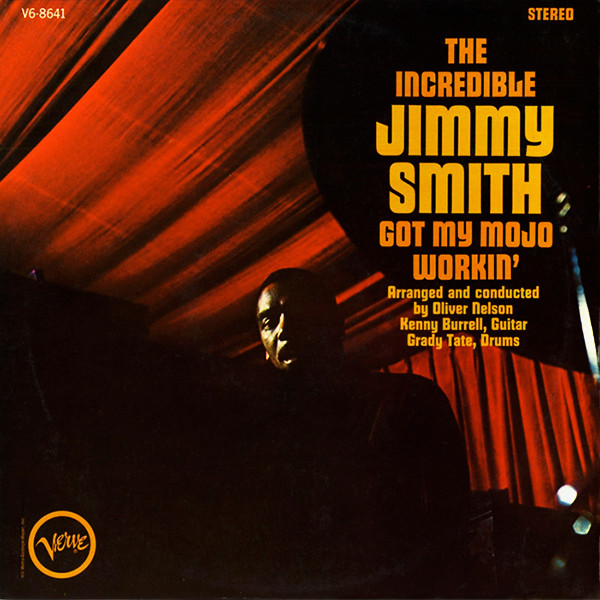
Got My Mojo Workin'
 View on Discogs
 View on Wikipedia
Album Summary
Back in 1966, when the Hammond B-3 was the undisputed king of the soul-jazz universe, Jimmy Smith dropped 'Got My Mojo Workin'' on Verve Records and reminded everybody exactly why he was the master of that magnificent machine. Recorded during the peak of Smith's run with Verve — the label that had been smart enough to recognize his genius and give him the room to let it breathe — this album found the Philadelphia-born organist in full command of his craft, surrounded by the kind of tight, greasy ensemble playing that made soul-jazz the most irresistible sound of the mid-1960s. Smith brought his signature Hammond B-3 thunder to a set that mixed blues-drenched originals with inspired readings of contemporary pop and rock material, proving once again that Jimmy Smith could take any song, any style, any groove, and make it entirely, unmistakably his own.
Reception
- The album connected with both jazz purists and soul music devotees, reflecting the broad crossover appeal Smith had cultivated throughout his tenure at Verve Records.
- Critics and audiences alike responded to the album's ability to bridge the gap between hard bop sophistication and the funkier, more accessible sensibilities of mid-1960s popular music.
- The record reinforced Smith's standing as one of the most commercially viable jazz artists of the era, drawing listeners from jazz, R&B, and funk communities simultaneously.
Significance
- This album stands as a defining document of the soul-jazz movement, demonstrating how Jimmy Smith synthesized hard bop tradition with blues roots and the emerging funk sensibility that would shape popular music for decades to come.
- Smith's decision to reimagine rock and pop material — including tracks like '(I Can't Get No) Satisfaction' and '1-2-3' — alongside blues and jazz staples was a bold statement about the Hammond B-3's power to transcend genre boundaries entirely.
- The title track and the album as a whole represent a crucial link between the blues tradition and jazz innovation, with Smith's organ serving as the living, breathing connective tissue between those two mighty rivers of American music.
Tracklist
-
A1 High Heel Sneakers 175
 5:03
5:03
-
A2 (I Can't Get No) Satisfaction 75
4:23
-
A3 1-2-3 133
4:00
-
A4 Mustard Greens 77
5:35
-
B1 Got My Mojo Workin' 165
7:30
-
B2 Johnny Come Lately 91
3:45
-
B3 C Jam Blues 103
3:47
-
B4 Hobson's Hop 165
4:00

Artist Details
Jimmy Smith was a Philadelphia-born Hammond B-3 organ wizard who single-handedly made the world fall in love with the soul jazz organ sound back in the mid-1950s, laying down grooves so deep and funky that cats like Larry Young and Brother Jack McDuff had to study his moves just to catch up. Recording for Blue Note starting in 1956, Smith brought the organ out of the church basement and onto the jazz stage, bridging the gap between bebop sophistication and the raw, greasy feel of rhythm and blues in a way nobody had ever done before. His records — from The Sermon to Back at the Chicken Shack — weren't just albums, they were blueprints for everything that came after, touching soul, funk, and even the early sounds of hip-hop sampling culture decades down the line.


