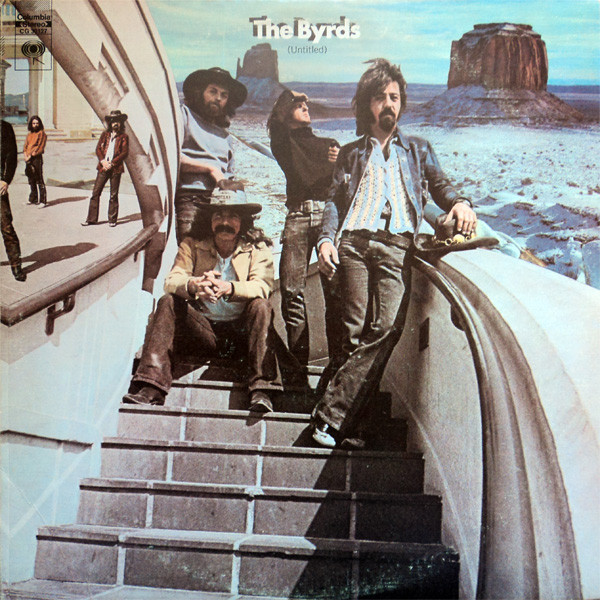
(Untitled)
 View on Discogs
 View on Wikipedia
Album Summary
Dropped in the fall of 1970 on Columbia Records, '(Untitled)' came out of a band that was searching — digging deep into themselves to find something real. This was a double album, part live and part studio, and it stands as one of the most honest documents The Byrds ever laid down to tape. Produced by the band themselves — a group at that point anchored by the brilliant and restless Roger McGuinn alongside the country-soul fire of Gram Parsons' spiritual successor Clarence White — the record captured The Byrds at a crossroads, stretching out on stage with muscular live performances while also exploring new studio terrain with a rootsy, unhurried confidence. It was their eleventh studio outing, and though the winds of change were howling all around them, these cats stepped up to the microphone and let it all hang out.
Reception
- The album made a modest showing on the Billboard 200, failing to recapture the commercial heights the band had known in their mid-1960s heyday, reflecting a marketplace that had moved on even as The Byrds were still evolving.
- Critical reception was mixed at the time of release, with some reviewers appreciating the raw energy of the live side while others felt the studio material didn't fully cohere into a unified statement.
- In the years since its release, the album has been reassessed more favorably by those who recognize it as a transitional document of real depth and sincerity.
Significance
- The live side of '(Untitled)' is a stone-cold testament to just how formidable The Byrds were as a performing unit in 1970 — stretching out on tracks like 'Eight Miles High' with a kind of extended, jazz-informed freedom that pointed toward what rock and roll could be when it refused to stay in the box.
- The studio side revealed a band leaning warmly into country-rock and Americana textures — years before that sound had a proper name — with 'Chestnut Mare' becoming one of the most beloved songs in the entire Byrds catalog, a poetic and cinematic piece that deserved far more radio love than it received.
- The album stands as a significant marker in the evolution of country-rock as a serious genre, with The Byrds synthesizing folk, gospel, psychedelia, and country influences into something that felt both timeless and urgently contemporary for the early 1970s.
Tracklist
-
A1 Lover Of The Bayou 112
 3:40
3:40
-
A2 Positively 4th Street 117
3:03
-
A3 Nashville West 106
2:00
-
A4 So You Want To Be A Rock 'N Roll Star —
2:37
-
A5 Mr. Tambourine Man 123
2:18
-
A6 Mr. Spaceman 107
3:11
-
B1 Eight Miles High 130
16:15
-
C1 Chestnut Mare 123
5:10
-
C2 Truck Stop Girl 141
3:19
-
C3 All The Things 108
3:05
-
C4 Yesterday's Train 83
3:32
-
C5 Hungry Planet 88
5:00
-
D1 Just A Season 117
3:54
-
D2 Take A Whiff 107
3:28
-
D3 You All Look Alike 86
3:04
-
D4 Well Come Back Home —
7:45

Artist Details
The Byrds were a visionary group out of Los Angeles, California, who came together in 1964 and proceeded to rewrite the rulebook by fusing the jangly twelve-string Rickenbacker sound with the poetic sensibility of Bob Dylan and the British Invasion, essentially birthing what the world would come to know as folk rock. With timeless cuts like "Mr. Tambourine Man" and "Turn! Turn! Turn!" these cats didn't just make music — they shaped the entire sonic landscape of the mid-to-late sixties and laid the groundwork for country rock, psychedelia, and beyond. The Byrds' influence runs so deep that you can hear their echo in just about every guitar-driven act that followed, making them one of the most quietly powerful forces in the whole history of American popular music.