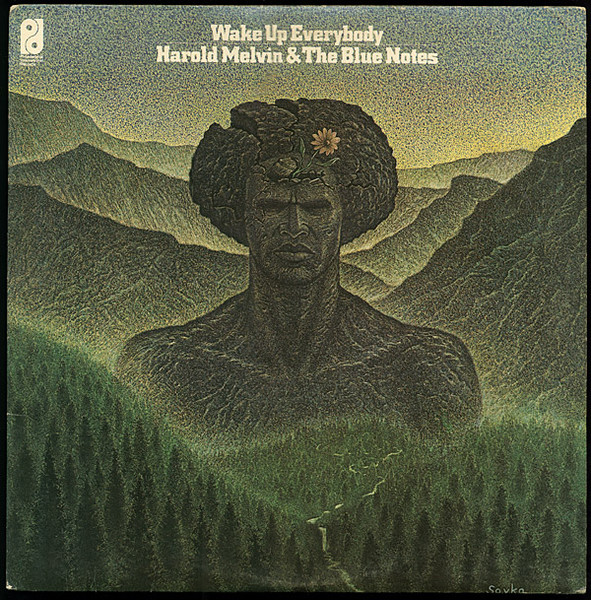
Wake Up Everybody
 View on Discogs
Album Summary
Wake Up Everybody arrived in 1975 on the mighty Philadelphia International Records, that hallowed home of lush strings, righteous grooves, and music that spoke directly to the soul of Black America. Produced under the guiding hands of Kenny Gamble and Leon Huff — the architects of the Philadelphia Sound — the album captured Harold Melvin and his Blue Notes at a peak moment, with the incomparable Teddy Pendergrass anchoring the vocal performances with a raw, burning intensity that few singers of any era could match. Alongside Harold Melvin, the ensemble featured John Atkins, Bernie Wilson, Lloyd Parks, Larry Brown, Jerry Cummings, Dwight Johnson, William Spratley, and David Ebo, a deep and committed brotherhood of sound that gave the record its full-bodied warmth. Released at a time when Philadelphia International was defining what sophisticated, message-driven soul could be, Wake Up Everybody carried both the shimmer of disco's rising tide and the moral weight of classic soul, a combination that felt urgent and alive.
Reception
- The title track 'Wake Up Everybody' became a significant soul and R&B hit, resonating strongly with audiences who responded to its message of social consciousness and uplift.
- The album reinforced Harold Melvin and the Blue Notes' standing as one of the premier vocal groups operating within the Philadelphia International stable, earning them continued respect from critics attuned to the Philly Sound.
- 'Don't Leave Me This Way' emerged as a standout moment, with Teddy Pendergrass's volcanic vocal performance drawing particular praise and helping cement the track as one of the defining Blue Notes recordings.
Significance
- Wake Up Everybody stands as a testament to the socially conscious wing of mid-1970s soul, with its title track calling listeners to awareness and collective responsibility at a moment when Black America was navigating a complex post-Civil Rights landscape.
- The album represents a pivotal chapter in Teddy Pendergrass's artistic ascent, his performances here broadcasting a star power so undeniable that his eventual solo career felt like an inevitability written in fire.
- Rooted in the Philadelphia International house style — orchestral arrangements, sophisticated chord progressions, and impeccable production from Gamble and Huff — the record helped define the bridge between classic soul and the emerging disco era, influencing the sound of urban music well into the late 1970s.
Samples
- "Wake Up Everybody" — one of the most beloved and revisited tracks in soul sampling culture, famously covered and interpolated across multiple generations of hip-hop and R&B, with its chorus and instrumental bed drawn upon by numerous artists seeking its uplifting, conscience-stirring energy.
- "Don't Leave Me This Way" — the searing Pendergrass-led performance has been a touchstone for producers and artists mining the Philadelphia soul catalog, with its emotional intensity and groove making it a recurring source for samples across R&B and hip-hop productions.
Tracklist
-
A1 Wake Up Everybody —
 7:30
7:30
-
A2 Keep On Lovin' You —
3:40
-
A3 You Know How To Make Me Feel So Good —
5:17
-
B1 Don't Leave Me This Way —
6:08
-
B2 Tell The World How I Feel About 'Cha Baby —
5:54
-
B3 To Be Free To Be Who We Are —
5:09
-
B4 I'm Searching For A Love —
5:23

Artist Details
Harold Melvin And The Blue Notes were a powerhouse Philadelphia soul and disco group who brought some of the deepest, most emotionally charged music to come out of the City of Brotherly Love during the 1970s. Anchored by the earth-shaking tenor of Teddy Pendergrass alongside bandleader Harold Melvin, the group found their home on Philadelphia International Records, where they helped define the lush, orchestrated sound that made Philly soul a movement unto itself. With a rotating cast of dedicated musicians including John Atkins, Bernie Wilson, Lloyd Parks, and others, the Blue Notes delivered performances that went straight to the gut and stayed there long after the record stopped spinning.