The Ghetto
 View on Discogs
Album Summary
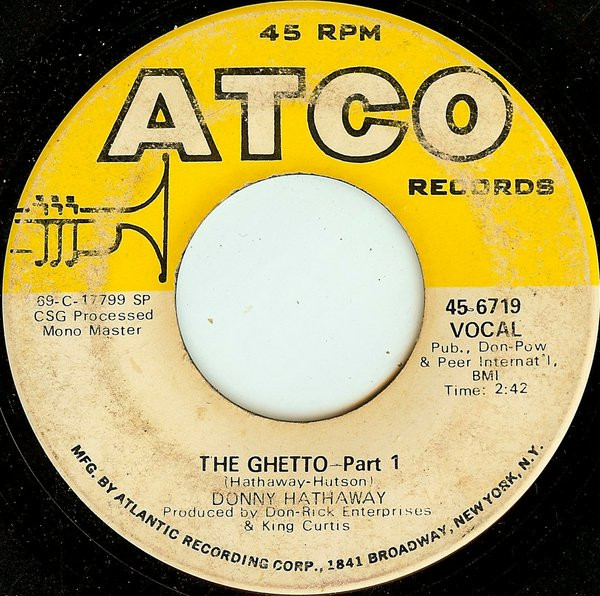
Released in 1969 on Atco Records, a subsidiary of the mighty Atlantic Records family, 'The Ghetto' arrived like a thunderclap from a young Donny Hathaway who was still finding his footing as a solo artist after years of sharpening his craft as a session musician and gospel-trained vocalist. Produced during a period when Atlantic was nurturing some of the most profound voices in soul music, the album captured Hathaway at a raw and hungry moment — a man with something deep and real to say about the world he saw around him. Recorded as the turbulence of the late 1960s hung heavy in the air, 'The Ghetto' reflected the social consciousness that was beginning to pulse through Black music like a heartbeat, with Hathaway channeling his gospel roots and classical training into a sound that felt both urgent and timeless.
Reception
- The album's title track resonated powerfully with R&B audiences attuned to the socially conscious soul movement emerging at the close of the 1960s, earning Hathaway recognition as a serious and soulful new voice on the scene.
- Critical ears of the era took note of Hathaway's extraordinary vocal depth and emotional authenticity, even as the album did not achieve immediate mainstream crossover success.
- The record established Hathaway's credibility within the soul community, signaling that a major talent had arrived — one who would not be easily forgotten.
Significance
- 'The Ghetto' stood as a bold early statement in the tradition of socially aware soul music, addressing the realities of urban African American life with honesty and grace at a time when that kind of truth-telling in music was both necessary and revolutionary.
- The album showcased Hathaway's rare ability to fuse his deep gospel foundation with contemporary soul sensibilities, a synthesis that would become the defining hallmark of his entire artistic legacy.
- By placing the struggles and spirit of the Black urban experience at the center of his music, Hathaway situated himself alongside visionaries like Curtis Mayfield and Marvin Gaye who were transforming soul music into a vehicle for profound social expression.
Samples
- The Ghetto - Part 1 — one of the most sampled recordings in soul and hip-hop history, with its infectious groove and raw energy drawn upon by countless producers across decades of hip-hop and R&B production.
Tracklist
-
A The Ghetto - Part 1 —
 2:42
2:42
-
B The Ghetto - Part 2 —
2:41

Artist Details
Donny Hathaway was a Washington D.C.-born soul genius whose rich, gospel-soaked voice and jazz-influenced arrangements made him one of the most gifted artists to ever grace the early 1970s R&B scene, recording landmark albums and unforgettable duets with Roberta Flack that melted right through the speakers and straight into your chest. His sound was a sacred blend of soul, gospel, and jazz, deeply rooted in his classical training at Howard University, and records like *Everything Is Everything* and *Live* showed a man who wasn't just singing songs — he was delivering sermons. Tragically taken far too soon in 1979, Hathaway's influence cast a long shadow over every soulful singer who came after him, from Luther Vandross to D'Angelo, cementing his legacy as one of the true unsung pillars of Black American music.