
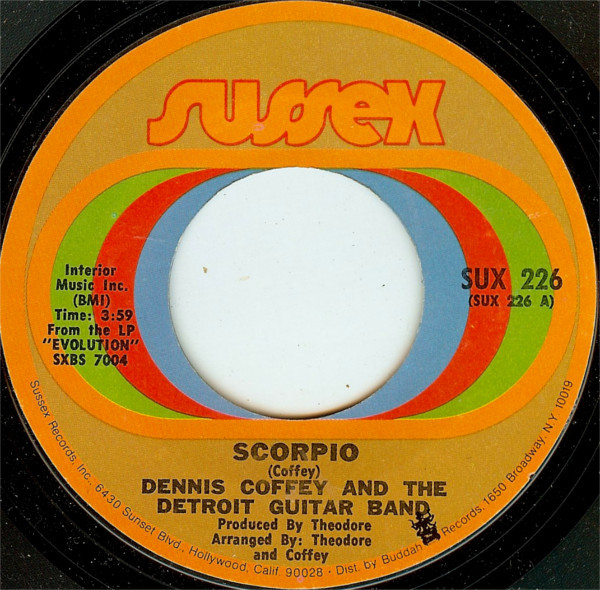
Scorpio
 View on Discogs
Album Summary
"Scorpio" came out in 1971 on Sussex Records, a label that had its finger right on the pulse of funk and soul. Dennis Coffey And The Detroit Guitar Band laid this one down right in the heat of Detroit's funk revolution, with the Sussex Records team holding it down on the production side. What they captured on this record was something special — Coffey's electric guitar wasn't just along for the ride, it was out front leading the charge, wrapped in the warm, gritty energy that only early 1970s Detroit could produce.
Reception
- The title track "Scorpio" broke through in a serious way commercially, putting Dennis Coffey on the map as a genuine innovator of funk guitar and earning him recognition well beyond the Detroit scene.
- The album connected deeply with funk and soul audiences, cementing the Detroit Guitar Band's standing as one of the era's most vital ensembles.
Significance
- "Scorpio" is a textbook document of the Detroit funk sound — rhythmic, ensemble-driven, and alive with a groove that felt like the city itself talking.
- Coffey used this album to make the case that the electric guitar belonged out front in funk music, not just holding down rhythm in the background, and that idea rippled through the genre for years to come.
- The record stands as an early and essential statement of funk guitar as a lead voice, influencing the direction that countless musicians would follow throughout the decade.
Samples
- "Scorpio" — one of the most heavily sampled tracks in hip-hop history, with uses spanning decades across countless artists and producers drawing on its iconic drum break and guitar riff.
Tracklist
-
A Scorpio —
 3:59
3:59
-
B Sad Angel —
3:40

Artist Details
Dennis Coffey and the Detroit Guitar Band were a funk and soul outfit that rose out of the Motor City in the early 1970s, with guitarist Dennis Coffey himself already a seasoned session legend who had laid down those wicked wah-wah licks on Motown classics for the Temptations and Edwin Starr. Their 1971 smash "Scorpio" was a groundbreaking blend of psychedelic funk and raw Detroit grit that cracked the pop charts and made Coffey one of the first white artists to hit number one on the R&B charts, a milestone that spoke volumes about the universal power of the groove. That record and their body of work helped bridge the worlds of rock guitar and Black soul music, cementing their place as unsung architects of the funk era and a foundation stone for the hip-hop producers who would sample their heavy rhythms decades later.