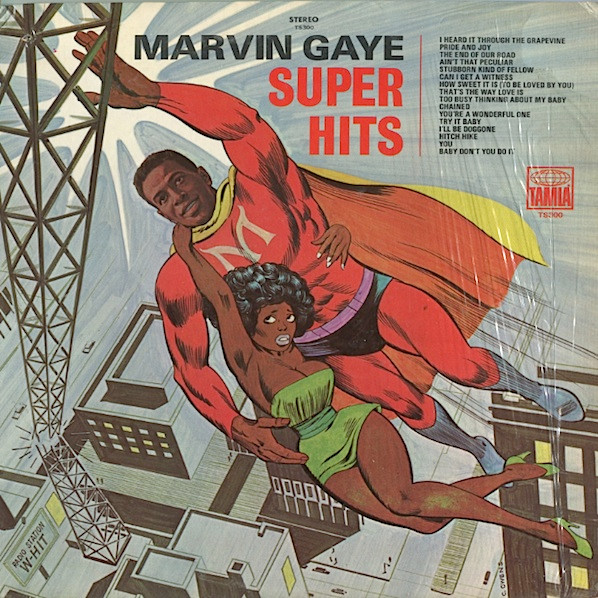
Super Hits
 View on Discogs
 View on Wikipedia
Album Summary
Released in 1970 on Berry Gordy's Tamla imprint — the same hallowed label that helped birth the Motown sound — 'Super Hits' was a carefully curated collection drawing from Marvin Gaye's remarkable run of singles throughout the 1960s. Rather than a studio album conceived as a whole, this was Tamla's loving testament to what Marvin had already built: a monument assembled from the bricks he'd been laying since 1963. The tracks were shaped by the Motown production machine, with key creative hands including William 'Mickey' Stevenson, Harvey Fuqua, and the legendary Holland-Dozier-Holland team guiding sessions at Hitsville U.S.A. in Detroit — that little house on West Grand Boulevard where so much soul history was born. It stands as a document of one of the most electrifying decades any singer has ever had.
Reception
- As a singles compilation, 'Super Hits' arrived with the built-in credibility of tracks that had already proven themselves on the charts and in the hearts of R&B listeners throughout the 1960s — 'I Heard It Through The Grapevine' alone had been a massive commercial and cultural force.
- The collection was embraced as an accessible entry point for fans who wanted the essential Marvin Gaye experience distilled onto a single record, reinforcing his reputation as one of Motown's premier vocal talents.
- Critical appreciation for the compilation grew over time as listeners recognized the sheer consistency of quality across all sixteen tracks, a body of work that made the case for Marvin Gaye as an artist without a weak moment in his catalog.
Significance
- This compilation captures Marvin Gaye at the peak of his classic Motown soul period, showcasing the vocal and emotional range that would make him one of the defining voices of twentieth-century American music — from the gritty stomp of 'Stubborn Kind Of Fellow' to the aching tenderness of 'How Sweet It Is (To Be Loved By You).'
- The sixteen tracks on 'Super Hits' represent a living archive of the Tamla/Motown soul style — tight rhythm sections, lush arrangements, and that ineffable Detroit groove — serving as a masterclass in how commercial soul music could carry genuine emotional weight.
- By gathering songs like 'Can I Get A Witness,' 'Hitch Hike,' and 'Pride And Joy' onto one record, the album underscored Marvin Gaye's pivotal role in shaping the vocabulary of soul and funk that younger artists and producers would spend the next several decades learning from and building upon.
Samples
- "I Heard It Through The Grapevine" — one of the most sampled tracks in soul history, with notable uses including California Raisins-era cultural ubiquity and interpolations across hip-hop and R&B spanning decades.
- "How Sweet It Is (To Be Loved By You)" — sampled and interpolated across numerous R&B and hip-hop productions, its warm groove and melodic hook proving irresistible to producers across generations.
- "Ain't That Peculiar" — sampled by various hip-hop and R&B artists drawn to its driving Motown rhythm and Marvin's pleading vocal delivery.
- "Hitch Hike" — its infectious groove has been lifted by hip-hop producers seeking that raw early-Motown energy.
- "Too Busy Thinking About My Baby" — sampled in hip-hop productions drawn to its buoyant, carefree Motown swing and Marvin's effortlessly cool vocal performance.
Tracklist
-
A1 I Heard It Through The Grapevine 117
 3:10
3:10
-
A2 Pride And Joy 121
2:09
-
A3 The End Of Our Road 103
2:49
-
A4 Ain't That Peculiar 81
2:57
-
A5 Stubborn Kind Of Fellow 108
2:47
-
A6 Can I Get A Witness —
2:46
-
A7 How Sweet It Is (To Be Loved By You) 112
2:59
-
A8 That's The Way Love Is 110
3:15
-
B1 Too Busy Thinking About My Baby 117
2:54
-
B2 Chained 99
2:37
-
B3 You're A Wonderful One 84
2:44
-
B4 Try It Baby 108
2:57
-
B5 I'll Be Doggone 133
2:47
-
B6 Hitch Hike 112
2:27
-
B7 You —
2:46
-
B8 Baby Don't You Do It 83
2:40

Artist Details
Marvin Gaye was a singular soul prophet born right out of Washington D.C. who found his groove in Detroit's Motown Records in the early 1960s, weaving together rhythm and blues, soul, and jazz into something so smooth and so deep it could make a grown man weep. He pushed the boundaries of what Motown would allow with landmark albums like What's Going On in 1971 and Let's Get It On in 1973, using his music to speak on Vietnam, poverty, and the raw hunger of human desire when other artists were playing it safe. His velvet voice and fearless artistry made him the undisputed Prince of Soul, and his influence runs so deep through the veins of every R&B and soul artist that came after him that you simply cannot tell the story of American music without his name front and center.