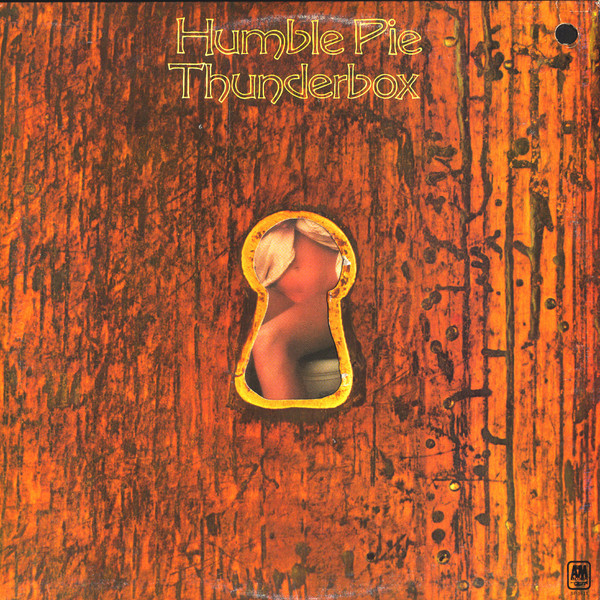
Thunderbox
 View on Discogs
 View on Wikipedia
Album Summary
Thunderbox came roaring out in 1974 on A&M Records, and what you had here was Humble Pie taking the wheel themselves — producing the record without the guiding hand of Glyn Johns, who had been their man in the studio for years prior. Recorded during a period when the band was fighting hard to keep that commercial fire burning after the extraordinary success of their live recordings, this album leaned deep into the greasy, sweat-soaked world of American R&B and soul. The sessions had a looser, more spontaneous feel to them — like a band playing from the gut rather than the blueprint — blending raw originals with soulful covers and delivering something grittier and less polished than what came before. It was Humble Pie stripped down, road-worn, and running on pure instinct.
Reception
- Thunderbox landed at number 52 on the Billboard 200 in the United States, a significant step back from the commercial heights the band had scaled in the early part of the decade.
- Critical reception fell somewhere between mixed and lukewarm, with reviewers acknowledging the album's raw energy and authenticity while pointing to a lack of focus and cohesion that kept it from making a stronger impact.
- The album did little to reverse the band's commercial slide, and it has since been regarded by most critics as a transitional, underperforming chapter in the Humble Pie story.
Significance
- Thunderbox stands as one of the most heartfelt expressions of Humble Pie's deep, abiding love for American R&B and soul music, with the band's choice of cover material making clear that their blues roots ran far deeper than the hard rock label the world had pinned on them.
- The album holds a bittersweet place in the band's history as one of the final recorded statements from the classic Humble Pie lineup, preserving that raw, combustible energy at a moment when the original formation was quietly beginning to come apart at the seams.
- Historically, Thunderbox marks a pivotal crossroads in the band's journey, reflecting the broader struggles faced by British hard rock acts in the mid-1970s as musical tastes shifted beneath their feet and the first great wave of early-70s rock momentum began to fade.
Tracklist
-
A1 Thunderbox 126
 5:16
5:16
-
A2 Groovin' With Jesus 80
2:18
-
A3 I Can't Stand The Rain 75
4:17
-
A4 Anna (Go To Him) 183
3:42
-
A5 No Way 156
2:48
-
A6 Rally With Ali —
2:49
-
B1 Don't Worry, Be Happy 160
2:54
-
B2 Ninety-Nine Pounds 116
2:47
-
B3 Every Single Day 124
3:46
-
B4 No Money Down 105
4:25
-
B5 Drift Away 142
3:57
-
B6 Oh La-De-Da 130
4:32

Artist Details
Humble Pie was a hard rock and blues-rock powerhouse that came together in England in 1969, born from the raw talent of former Small Faces frontman Steve Marriott and a young Peter Frampton, cooking up a sound so heavy and soulful it could shake the walls of any arena they stepped foot in. They carved out a righteous place in rock history as one of the pioneering forces of hard rock and early heavy metal, their live album Performance: Rockin' the Fillmore becoming a testament to just how fierce and unbridled rock and roll could be in the early seventies. Humble Pie never quite got the mainstream recognition they deserved, but among the faithful who knew their music, they were nothing short of a religion — a gritty, sweaty, beautiful religion.