Beginnings
 View on Discogs
 View on Wikipedia
Album Summary
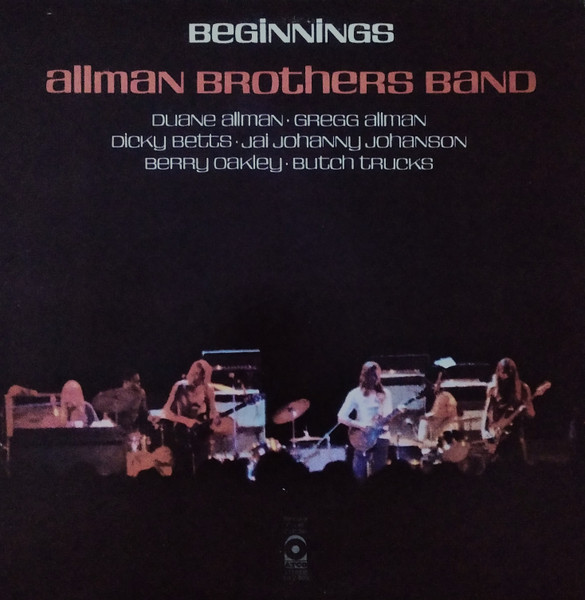
"Beginnings" arrived in 1973 on Capricorn Records, and baby, this was not just another album drop — this was a love letter to where it all started. The Allman Brothers Band, those magnificent sons of the Southern soil, put together this collection drawing from their self-titled 1969 debut and their 1973 follow-up "Idlewild South," giving the world a chance to sit with the roots of something truly special. Produced with the masterful touch of Tom Dowd alongside the band themselves, this record captured the raw, searching energy of a group that was still finding the edges of what Southern rock could be — all that intertwining dual-guitar alchemy, those deep blues foundations, and a spirit that was equal parts Muscle Shoals and midnight highway. Coming off the thunderous success of "At Fillmore East" and "Eat a Peach," "Beginnings" gave listeners a chance to go back to the well and understand just how deep that water had always been.
Reception
- The album performed respectably on the Billboard 200, reflecting the band's sustained commercial momentum during one of the most fertile periods in Southern rock history.
- Critics embraced "Beginnings" as an essential document of the Allman Brothers Band's early studio vision, praising the cohesion and emotional depth of the recordings.
- The album reinforced the band's standing as architects of a new American rock sound, earning reverence from fans and tastemakers alike who recognized the foundational power of these performances.
Significance
- "Beginnings" stands as one of the most important artifacts in Southern rock history, showcasing the Allman Brothers Band's fearless blending of Delta blues, country soul, and hard rock into something that felt wholly and undeniably American.
- Tracks like "Whipping Post," "Dreams I'll Never See," and "In Memory Of Elizabeth Reed" illustrate the band's extraordinary command of extended instrumental improvisation and dual lead guitar interplay — a sonic language that rewrote the rules for rock music in the 1970s.
- The album captures a band in the process of becoming legends, and its presence in the cultural conversation helped cement the Allman Brothers Band as the cornerstone of the jam-band and Southern rock traditions that would echo through decades of American music.
Tracklist
-
A1 Don't Want You No More 134
 2:25
2:25
-
A2 It's Not My Cross To Bear 129
5:02
-
A3 Black Hearted Woman 111
5:08
-
A4 Troubles No More —
3:45
-
B1 Every Hungry Woman 98
4:13
-
B2 Dreams I'll Never See —
7:18
-
B3 Whipping Post 97
5:17
-
C1 Revival —
4:04
-
C2 Don't Keep Me Wonderin' —
3:40
-
C3 Midnight Rider —
3:00
-
C4 In Memory Of Elizabeth Reed —
6:54
-
D1 Hoochie Coochie Man —
4:54
-
D2 Please Call Home —
4:00
-
D3 Leave My Blues At Home —
4:15

Artist Details
The Allman Brothers Band rose up out of Macon, Georgia in 1969 like a slow-burning fire that nobody could put out, built on the visionary genius of brothers Duane and Gregg Allman, who fused the raw soul of the blues with the free-spirited improvisation of jazz and rock to birth something the world would come to call Southern rock. Their landmark live album *At Fillmore East* from 1971 stands as one of the greatest recordings in all of American music, capturing that loose, sprawling, guitar-driven sound that could take a crowd on a twenty-minute journey and leave them breathless. Through tragedy, breakups, and rebirths, the Allman Brothers proved that their music was bigger than any single moment, leaving behind a legacy that cracked open the American South and showed the whole world the depth and beauty living inside it.