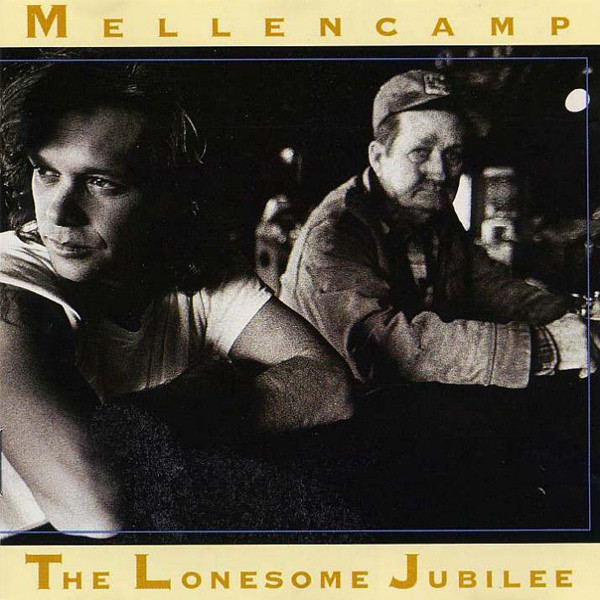
The Lonesome Jubilee
 View on Discogs
 View on Wikipedia
Album Summary
Now here's an album that came straight from the heartland and hit you right in the chest — The Lonesome Jubilee, released in 1987 on Mercury Records, produced by John Mellencamp himself alongside the trusted Don Gehman, a man who knew Mellencamp's sonic vision like a second skin. They took this record home — literally — laying it down at Belmont Mall Studios in Belmont, Indiana, deep in the Midwest soil that raised the man and shaped every note he ever wrote. And what they built there was something special, something that went beyond the rock and roll framework Mellencamp had been working in. This time around, he stretched out — brought in fiddle, accordion, dobro, and banjo — not as decoration, not as novelty, but as the full and breathing soul of the music. It was a deliberate turn toward the old American sounds, the folk and roots traditions that run under this country like underground rivers, and he married them to his rock foundation with a conviction that made the whole thing feel like it had always existed, waiting to be found.
Reception
- The Lonesome Jubilee came in swinging on the charts, climbing all the way to number six on the Billboard 200, and it gave the people not one but two top-ten singles in Paper In Fire and Cherry Bomb — proof that artistic ambition and commercial muscle could walk the same road.
- The critics, bless them, recognized what Mellencamp had done here, hailing the album as one of his most ambitious and fully realized works, praising the seamless fusion of heartland rock with Appalachian and country folk influences as something bold, authentic, and genuinely earned.
- The album pulled in a Grammy nomination and showed up on best-of lists across the board come year-end 1987, cementing its place as a record that mattered both in the marketplace and in the hearts of people who cared about where American music was going.
Significance
- The Lonesome Jubilee stands as a true landmark in heartland rock, not just refining the genre but expanding its very walls — by centering traditional acoustic American instrumentation in a rock context, Mellencamp gave the music a sense of national identity that felt ancient and immediate all at once.
- The album carried real weight in the world beyond music — its unflinching lyrical focus on economic hardship, working-class struggle, and the fraying of rural American community spoke directly to a country living through genuine rural economic decline, giving The Lonesome Jubilee a sociopolitical resonance that most rock records of its era never even reached for.
- In bringing fiddle, dobro, and accordion to the forefront as essential voices rather than background color, The Lonesome Jubilee arrived ahead of its time, laying groundwork for the Americana movement that would rise in the 1990s and quietly pointing a generation of artists back toward the folk and country roots that rock music had drifted away from.
Tracklist
-
A1 Paper In Fire —
 3:53
3:53
-
A2 Down And Out In Paradise —
3:39
-
A3 Check It Out —
4:20
-
A4 The Real Life —
3:56
-
A5 Cherry Bomb —
4:49
-
B1 We Are The People —
4:16
-
B2 Empty Hands —
3:44
-
B3 Hard Times For An Honest Man —
3:28
-
B4 Hotdogs And Hamburgers —
4:04
-
B5 Rooty Toot Toot —
3:29

Artist Details
John Cougar Mellencamp, born in Seymour, Indiana in 1951, burst onto the heartland rock scene in the late 1970s and early 80s with a blue-collar grit and a Springsteen-esque thunder that spoke straight to the soul of working-class America — records like Jack and Diane and Small Town weren't just songs, baby, they were dispatches from the forgotten corners of the Midwest. His blend of roots rock, R&B, and raw Americana earned him a place among the giants, and his tireless advocacy for family farmers through the Farm Aid movement he co-founded in 1985 alongside Willie Nelson and Neil Young cemented his legacy as more than just a rock and roller — he was a voice for the people. Mellencamp's catalog stands as a monument to American storytelling, influencing generations of artists who understood that the most powerful music comes from the truth of where you came from.