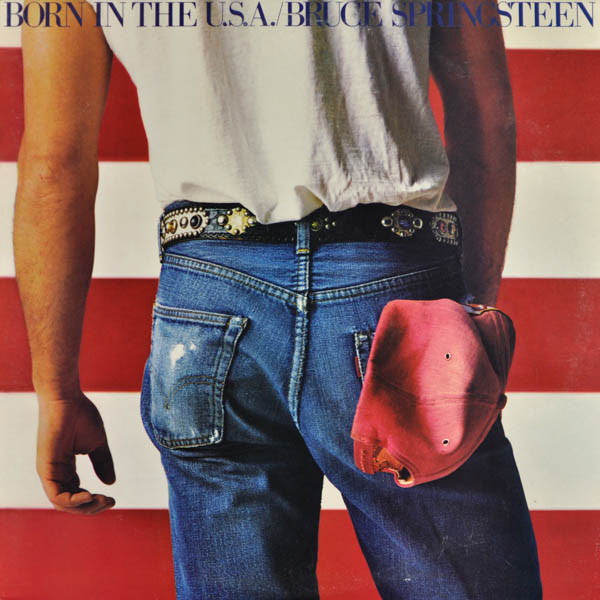
Born In The U.S.A.
 View on Discogs
 View on Wikipedia
Album Summary
Born in the U.S.A. came roaring out of sessions held primarily at The Power Station in New York, with Bruce Springsteen and his team laying down tracks between 1982 and 1984 — and baby, the world was never quite the same after June 4th of that year when Columbia Records turned it loose on the public. Produced by Springsteen alongside the steady hands of Steven Van Zandt and Chuck Plotkin, this record marked a bold and deliberate turn toward synthesizers and drum machines, giving Springsteen's working-class poetry a sheen and a thunder that could fill arenas and pour out of car radios from coast to coast. It was a sonic evolution — one that planted heartland rock firmly in the middle of the 1980s without ever losing the soul that made The Boss the voice of a generation.
Reception
- Born in the U.S.A. climbed straight to the top, hitting number one on the Billboard 200 and holding court on that chart for an extraordinary 139 weeks — the kind of staying power that doesn't come around but once in a blue moon.
- The album launched seven Top 10 singles on the Billboard Hot 100, including the title track, Dancing In The Dark, Cover Me, and I'm On Fire — a commercial run that left jaws on the floor across the entire music industry.
- Critical reception had its complications early on, with some purists raising an eyebrow at the synth-heavy production, but the emotional truth running through every groove eventually won over even the skeptics who thought they knew what Bruce Springsteen was supposed to sound like.
Significance
- Born in the U.S.A. pulled off something genuinely remarkable — it took Springsteen's unflinching portraits of Vietnam veterans, shuttered factories, and fading American dreams and delivered them straight into the heart of the MTV mainstream, making working-class struggle anthemic at a time when Reagan's America preferred to look the other way.
- The album became one of the most culturally misread and debated records of its era, with the thundering title track mistaken for patriotic celebration when Springsteen was in fact laying bare the broken promises handed to a generation of veterans — a tension that gave the record a power and a complexity that only deepened with time.
- With its massive, stadium-ready production and synth-driven sound, Born in the U.S.A. helped write the rulebook for arena rock in the 1980s, proving that a record could be both a pop juggernaut and a document of genuine human pain without compromising either.
Samples
- Dancing In The Dark — one of the most referenced and sampled tracks of the 1980s, with its synthesizer hook and rhythmic drive finding their way into hip-hop and electronic productions across subsequent decades.
- Born In The U.S.A. — the iconic drum machine intro and anthemic structure have been sampled and interpolated by various artists drawn to its instantly recognizable sonic identity.
Tracklist
-
A1 Born In The U.S.A. 123
 4:39
4:39
-
A2 Cover Me 123
3:26
-
A3 Darlington County 119
4:48
-
A4 Working On The Highway 184
3:11
-
A5 Downbound Train 120
3:35
-
A6 I'm On Fire 178
2:36
-
B1 No Surrender 152
4:00
-
B2 Bobby Jean 133
3:46
-
B3 I'm Goin' Down 136
3:29
-
B4 Glory Days 117
4:15
-
B5 Dancing In The Dark 148
4:01
-
B6 My Hometown 116
4:33

Artist Details
Bruce Springsteen, the hardworking son of New Jersey, burst onto the scene in the early 1970s out of Asbury Park with his E Street Band, crafting a sound so rich and cinematic it felt like the American highway itself was singing — equal parts rock and roll thunder, blues grit, and blue-collar poetry. The Boss, as the people came to call him, became the beating heart of working-class America, with landmark records like Born to Run and Darkness on the Edge of Town turning everyday struggle into something transcendent and holy. His music didn't just top the charts — it told the truth about a generation grinding through hard times, making him one of the most important storytellers rock and roll has ever known.