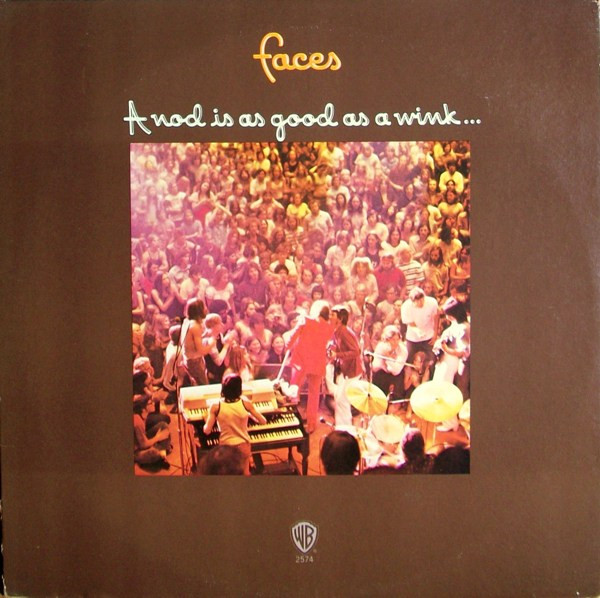
A Nod Is As Good As A Wink...To A Blind Horse
 View on Discogs
Album Summary
A Nod Is As Good As A Wink...To A Blind Horse came roaring out in November 1971 on Warner Bros. Records, and baby, when this record dropped, it felt like the whole neighborhood had pulled up to the party at once. Produced by the masterful Glyn Johns — the same cats-in-the-know producer who'd been behind the glass for The Rolling Stones and The Who — this was the Faces staking their claim as the baddest, loosest, most gloriously untamed rock and roll band on the planet. Rod Stewart out front doing what only Rod can do, Ronnie Wood slinging guitar like a man who invented cool, Ian McLagan tickling those keys with pure mischief, and the rhythm section of Kenney Jones holding the whole beautiful mess together — this was their third studio album, and it was the moment the world finally caught up to what the faithful already knew.
Reception
- The album climbed to number 2 on the UK Albums Chart, making it one of the most commercially triumphant moments in the Faces' career.
- It earned gold certification in the United States and made its presence known on the Billboard 200, proving that this brand of soulful British rock and roll had real crossover muscle.
- Critics received the album with genuine warmth, celebrating the band's unpolished, kinetic energy and their refusal to sand down the rough edges that made them so irresistible.
Significance
- This album stands as one of the purest expressions of the early-1970s British rock boogie movement, rooted deep in the blues and soaked in a joyful, communal spirit that few records before or since have ever matched.
- A Nod Is As Good As A Wink represents the Faces firing on all cylinders at their creative and commercial peak — a rare moment where Rod Stewart's ascending star power and the band's collective chemistry existed in perfect, glorious tension.
- The album's loose, raucous aesthetic helped lay the foundation for the bar-rock and stadium rock sounds that would define the rest of the decade, influencing generations of bands who understood that sometimes the most powerful thing a record can do is make people feel alive.
Samples
- "Stay With Me" — one of the most recognizable tracks in the Faces catalog, the song's strutting groove and raw rock energy have made it a recurring source for samplers seeking authentic early-seventies rock texture.
Tracklist
-
A1 Miss Judy's Farm 112
 3:38
3:38
-
A2 You're So Rude 107
3:41
-
A3 Love Lives Here 134
3:04
-
A4 Last Orders Please 122
2:33
-
A5 Stay With Me 91
4:37
-
B1 Debris 73
4:36
-
B2 Memphis —
5:29
-
B3 Too Bad 163
3:12
-
B4 That's All You Need 154
5:06

Artist Details
Faces were a magnificent, loose-limbed rock and roll outfit that came together in London in 1969, born from the ashes of the Small Faces when Rod Stewart and Ron Wood came sliding in to join Kenney Jones, Ian McLagan, and Ronnie Lane, creating one of the most gloriously ramshackle and soulful bands Britain ever produced. Their sound was a beautiful, whiskey-soaked blend of rock, R&B, and rhythm and blues — raw, ragged, and full of heart — best captured on albums like *A Nod Is as Good as a Wink... to a Blind Horse*, which showed the world that music could be both loose and transcendent at the same time. Though internal tensions and Rod Stewart's parallel solo stardom eventually pulled them apart by 1975, Faces left a fingerprint on rock and roll that runs deep through the DNA of every band that ever believed in the holy power of a good time played loud and from the soul.