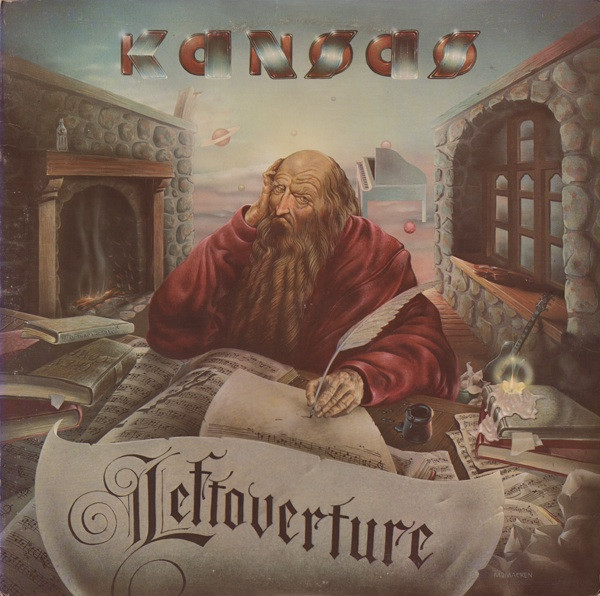
Leftoverture
 View on Discogs
 View on Wikipedia
Album Summary
Leftoverture came roaring out of the American heartland in September of 1976, released on Kirshner Records and produced by the gifted Jeff Glixman, who understood exactly what Kansas was reaching for and helped them grab it with both hands. Recorded in 1975 during a period when the band was road-hardened and creatively on fire, this third studio album captured six young men from Topeka at the peak of their early progressive rock ambitions — violin screaming, organs swelling, guitars cutting like a razor through the Kansas plains. Glixman would go on to be a trusted partner in the Kansas story, but this was the record that proved the partnership was something special, a meeting of artistic vision and sonic execution that the world was not quite ready for but absolutely needed.
Reception
- Leftoverture climbed all the way to number 5 on the Billboard 200, a remarkable achievement for a progressive rock record and a testament to the sheer force of what Kansas had created.
- The album was certified triple platinum in the United States, reaching far beyond the loyal prog faithful and finding its way into the hearts of mainstream rock listeners across the country.
- Critics took notice of the band's extraordinary musicianship and the album's ambitious arrangements, recognizing Leftoverture as a serious artistic statement from a band that refused to be underestimated.
Significance
- Leftoverture announced to the world that American progressive rock was not just a pale imitation of its British predecessors — Kansas had forged something distinctly their own, philosophically restless and musically ferocious, and this album was the proof.
- The record showcased the band's singular voice through intricate violin and keyboard arrangements woven together with angular guitar work and lyrics that wrestled with questions of faith, nature, and human purpose, setting Kansas apart from every other band on the radio.
- Leftoverture demonstrated with grace and power that progressive rock could achieve genuine mainstream commercial success without surrendering one ounce of its artistic soul, and that truth changed the conversation about what the genre could be in the mid-to-late 1970s.
Tracklist
-
A1 Carry On Wayward Son 123
 5:13
5:13
-
A2 The Wall 171
4:47
-
A3 What's On My Mind 118
4:27
-
A4 Miracles Out Of Nowhere 106
6:29
-
B1 Opus Insert 130
4:26
-
B2 Questions Of My Childhood 105
3:38
-
B3 Cheyenne Anthem 145
6:50

Artist Details
Kansas is a progressive rock band that came roaring out of Topeka, Kansas in 1973, blending hard rock muscle with symphonic strings, soaring violin, and deeply philosophical lyrics that hit you somewhere between the heart and the cosmos. These Midwestern boys carved out something truly unique in a rock landscape dominated by coastal sounds, delivering arena-filling anthems like Carry On Wayward Son and Dust in the Wind that proved you didn't need to be from New York or Los Angeles to shake the foundation of American rock and roll. Their run through the mid-to-late seventies stands as a testament to the idea that heartland America had something profound to say, and Kansas said it louder and more beautifully than just about anybody.