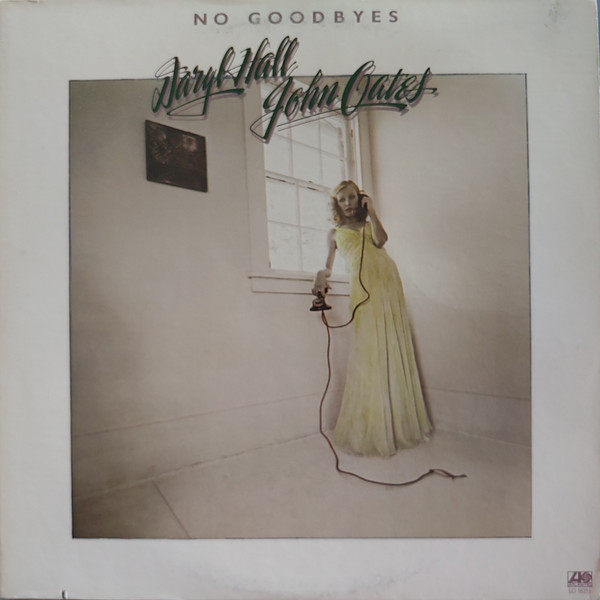
No Goodbyes
 View on Discogs
 View on Wikipedia
Album Summary
No Goodbyes arrived in 1977, but this one's got a backstory worth savoring — Atlantic Records, seeing the growing commercial heat around Hall & Oates, reached back into the vault and compiled this collection of early recordings the duo had laid down during their formative years on the label, spanning sessions from 1971 through 1974. Produced across various sessions that captured the raw, searching energy of two young Philadelphia talents still finding their footing, the album brought together tracks that had previously slipped under the radar or gone largely unheard by the wider audience the duo was now commanding. Atlantic released it to capitalize on the momentum Hall & Oates had built with their blue-eyed soul sound, giving fans a chance to hear where these brothers in harmony had come from before the spotlights got so bright.
Reception
- No Goodbyes landed as a retrospective release rather than a fresh studio statement, meaning it didn't chart with the same muscle as the duo's contemporaneous work, but it served as a warm document for fans hungry to dig deeper into the Hall & Oates catalog.
- Critics of the era received it as a curiosity piece — a fascinating glimpse into the early artistry of two musicians who were clearly still cooking up something special, even if the commercial machinery wasn't fully in gear yet.
- The album didn't generate significant chart action on the Billboard 200, but its value was always more archival than competitive, offering a portrait of Hall & Oates before the big pop breakthrough years fully arrived.
Significance
- No Goodbyes stands as a vital archaeological dig into the early soul-rock fusion experiments of Hall & Oates, revealing how deeply the Philadelphia sound and classic R&B influences were baked into their DNA from the very beginning.
- Tracks like 'She's Gone' — one of the duo's most enduring early recordings — anchor the album and demonstrate the extraordinary vocal chemistry between Daryl Hall and John Oates that would go on to reshape the landscape of blue-eyed soul throughout the decade.
- The album serves as a compelling document of the early 1970s singer-songwriter era filtered through a distinctly Philadelphia lens, capturing two artists bridging the gap between classic soul tradition and the rock sensibility that was reshaping popular music all around them.
Samples
- She's Gone — this tender, aching track built a quiet sampling legacy over the years, finding its emotional chord progressions and vocal energy tapped by hip-hop and R&B producers drawn to its raw soulfulness.
Tracklist
-
A1 It's Uncanny —
 3:43
3:43
-
A2 I Want To Know You For A Long Time —
3:17
-
A3 Can't Stop The Music (He Played It Much Too Long) —
2:49
-
A4 Love You Like A Brother —
3:20
-
A5 Las Vegas Turnaround (The Stewardess Song) —
2:57
-
B1 She's Gone —
5:15
-
B2 Lilly (Are You Happy) —
4:10
-
B3 When The Morning Comes —
3:12
-
B4 Beanie G. And The Rose Tattoo —
3:00
-
B5 70's Scenario —
3:57

Artist Details
Daryl Hall and John Oates are an American musical duo who met at Temple University in Philadelphia, Pennsylvania in 1967 and began recording together in the early 1970s. Their sound blends rock and roll with rhythm and blues, soul, and pop, creating a signature style often referred to as blue-eyed soul that set them apart from their contemporaries. The duo became one of the best-selling music acts of all time, achieving massive commercial success throughout the late 1970s and 1980s with a string of chart-topping hits including Rich Girl, Kiss on My List, Private Eyes, Maneater, and Out of Touch. Their ability to seamlessly fuse white rock sensibilities with Black musical traditions helped bridge audiences and contributed to the mainstream popularization of soul-influenced pop during the MTV era. Hall and Oates were inducted into the Rock and Roll Hall of Fame in 2014, cementing their legacy as pioneering figures in American popular music whose influence can be heard in countless artists that followed.