Russian Roulette
 View on Discogs
 View on Wikipedia
Album Summary
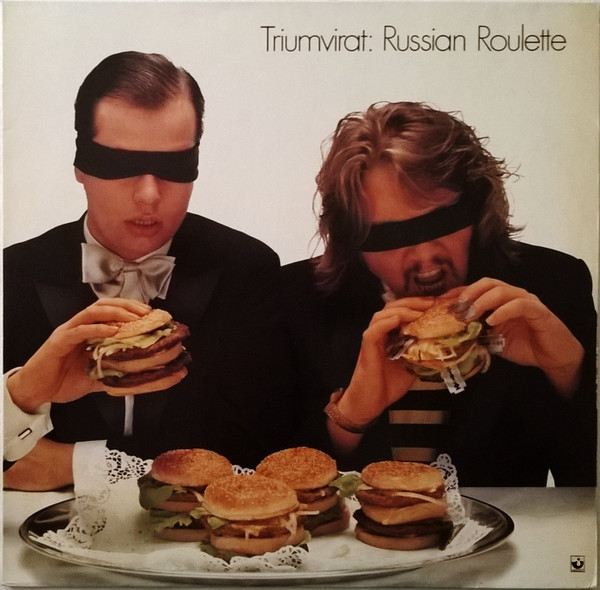
Russian Roulette stands as the final studio album from Triumvirat, the Cologne-based keyboard-driven progressive rock trio, released in 1980 on the storied Harvest Records label. Recorded during a period of real transition — both for the band and for progressive rock itself — the album captured a group that had poured everything into one last statement before the curtain came down on their original run. The turn of the decade brought new pressures and new sounds swirling around every studio in Europe, and Triumvirat stepped into that uncertain climate and laid down what would become their swan song, closing out a chapter that had begun with such fire and ambition in the early seventies.
Reception
- The album received moderate attention in European markets, finding its warmest audience in Germany and the UK, though it did not recapture the commercial momentum of Triumvirat's celebrated mid-seventies releases.
- Critical reception at the time was mixed, with reviewers recognizing the band's formidable technical musicianship while observing a notable shift away from the densely layered progressive rock architecture that had defined their earlier work.
Significance
- Russian Roulette documented Triumvirat's enduring commitment to keyboard-driven progressive rock, with Horst Stachelhaus's Hammond organ and synthesizer work remaining the beating heart of the album's elaborate arrangements across tracks like The Ballad Of Rudy Törner and the title track Russian Roulette.
- Released at the very turn of the decade, the album stands as a vivid historical marker of progressive rock's crossroads moment in 1980, when the genre faced the rising tide of new wave and synthesizer-pop and bands were being forced to either adapt or step aside.
- As the closing statement of Triumvirat's original era, Russian Roulette holds genuine historical weight in the progressive rock canon, documenting the band's full creative arc from their ambitious beginnings through to their dissolution.
Tracklist
-
A1 Party Life —
 3:28
3:28
-
A2 You Can't Catch Me —
4:08
-
A3 Come With Me —
3:59
-
A4 Games —
4:14
-
A5 Cooler —
4:30
-
A6 The Ballad Of Rudy Törner —
4:20
-
B1 We're Rich On What We've Got —
4:09
-
B2 Twice —
2:44
-
B3 Rien Ne Vas Plus —
4:40
-
B4 Roxy —
6:32
-
B5 Russian Roulette —
5:46

Artist Details
Triumvirat was a magnificent German keyboard-driven progressive rock trio that emerged out of Cologne in the early 1970s, crafting lush, orchestral soundscapes that drew heavy inspiration from the grandiose work of Emerson, Lake & Palmer and Yes, weaving together classical music sensibilities with rock muscle in a way that made them one of Europe's most compelling prog acts of the decade. Albums like Illusions on a Double Dimple and Spartacus showcased their breathtaking technical prowess and cinematic ambition, earning them a devoted international following and real respect on both sides of the Atlantic. Though they never quite broke through to mainstream superstardom, Triumvirat stands as a shining example of that golden era when musicians dared to dream big, blending the high art of the concert hall with the raw electricity of rock and roll.