Bodyheat
 View on Discogs
 View on Wikipedia
Album Summary
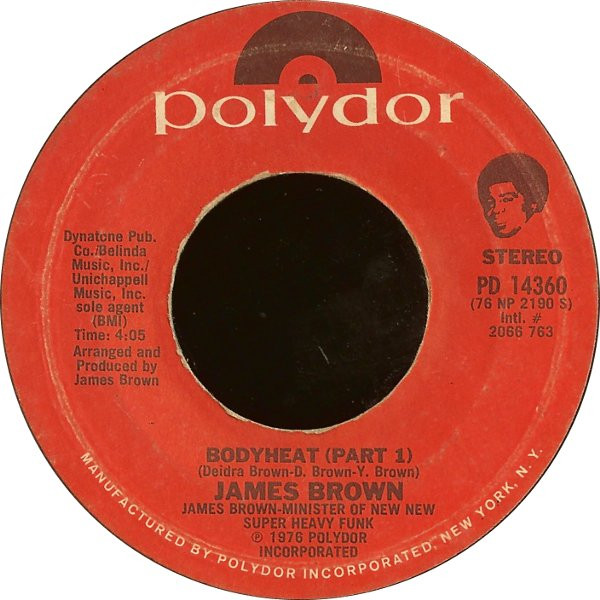
Back in 1976, the Godfather of Soul stepped into the studio and laid down something that was equal parts fire and finesse — that was 'Bodyheat,' released through Polydor Records and produced by the man himself, James Brown. Now, Brown had always been the architect of his own sound, and that hands-on mastery was all over this record. Coming out at a moment when the music world was caught between the gritty, sweat-soaked temples of funk and the glittering dance floors of disco, Brown made a deliberate move toward a smoother, more polished groove without ever letting go of that rhythmic intensity that made him a legend. 'Bodyheat' was James Brown reading the room, feeling the shift in the air, and doing what only he could do — making it his own.
Reception
- The title track performed solidly on the R&B charts, proving that Brown's connection to the Black music audience remained strong and unbroken even as the commercial dominance he had enjoyed in the late 1960s and early 1970s had begun to settle into a different kind of cultural authority.
- Critical response to the album was mixed, with some reviewers feeling that the smoother, disco-influenced sheen represented a departure from the raw funk blueprint that had made Brown a revolutionary force, reading it more as trend-chasing than artistic evolution.
- Despite not breaking through as a landmark commercial triumph, 'Bodyheat' kept Brown firmly in the conversation on the soul and funk circuit during one of the most competitive periods in the history of Black popular music.
Significance
- Released at the precise crossroads where hard funk and disco were negotiating territory, 'Bodyheat' captures a pivotal and historically rich moment in Brown's career — the tension between a giant's established identity and the commercial gravity of a rapidly shifting musical landscape.
- The record stands as a vital cultural document of how the originators of funk were required to adapt, evolve, and compete during the disco boom, making it an essential artifact for understanding the transformation of Black popular music in 1976.
- Brown's insistence on self-production throughout this era, evident across every groove on 'Bodyheat,' reflects a fierce artistic autonomy that set him apart from his contemporaries and reinforced his legacy as one of the most self-determined figures in the history of American music.
Samples
- Bodyheat (Part 1) — one of the most recognized rhythmic sources from Brown's mid-1970s catalog, with its groove and percussion having been tapped by hip-hop producers across multiple decades as a foundational funk bed.
- Bodyheat (Part 2) — sampled within the broader hip-hop and dance music communities, carrying on Brown's legacy as perhaps the single most influential figure in the history of sample-based music production.
Tracklist
-
A Bodyheat (Part 1) —
 4:05
4:05
-
B Bodyheat (Part 2) —
4:39

Artist Details
James Brown, the self-proclaimed Godfather of Soul, rose up out of Barnwell, South Carolina, and by the early 1960s had set the whole world on fire with a raw, sweat-drenched blend of gospel fervor, rhythm and blues grit, and a rhythmic intensity that would eventually birth the very foundation of funk itself. His band was so tight, so deeply locked in the groove, that Brown virtually invented a new musical language — one built on syncopated rhythm, punishing horn stabs, and a vocal ferocity that no human being had any right to possess — and that language went on to shape soul, funk, hip-hop, and beyond. James Brown wasn't just a musician; he was a cultural earthquake, a symbol of Black pride and power whose anthem "Say It Loud – I'm Black and I'm Proud" landed in 1968 like a thunderclap across a nation in the thick of the Civil Rights Movement, cementing his place not just in music history, but in the very story of America itself.