
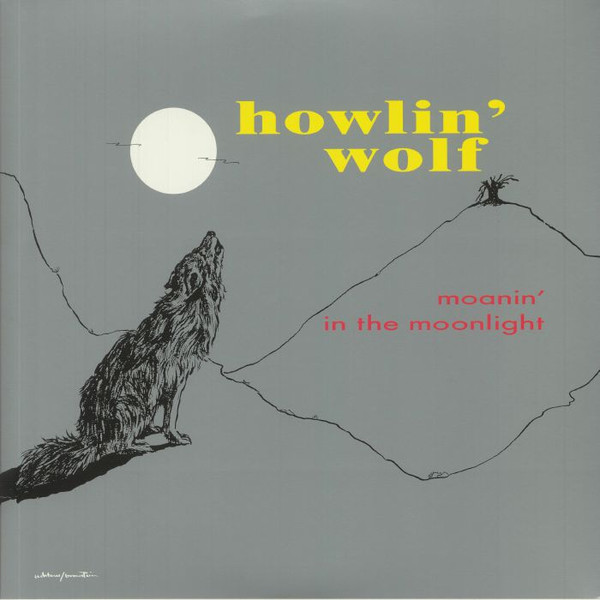
Moanin' In The Moonlight
 View on Discogs
Album Summary
Moanin' In The Moonlight is the debut album from Chester Arthur Burnett — the man the world came to know and fear as Howlin' Wolf — released in 1959 on Chess Records, later made available to European audiences through the DOL label. Rather than a conventional studio session conceived from the ground up as an album, this collection drew together some of the most visceral sides Wolf had already laid down in Chicago for Chess, with the legendary Leonard Chess and Willie Dixon instrumental in shaping the sessions that produced these recordings. It arrived at a moment when Chess was packaging its blues giants for a broader audience, and what they put together here was nothing short of a document of raw, uncut Chicago Blues power — Wolf's thunderous voice and commanding presence captured on wax for the ages.
Reception
- Upon its release, Moanin' In The Moonlight was embraced by blues aficionados as a definitive statement of Chicago Blues at its most elemental, with critics recognizing Wolf's voice as one of the most distinctive and commanding in American music.
- The album did not chart in any conventional pop sense, as the mainstream chart infrastructure of the era rarely reflected the reach and impact of blues recordings, but it moved deeply through African American communities and among the growing white blues audience.
- Over the decades, critical reassessment has elevated Moanin' In The Moonlight to essential-listening status, with music historians consistently citing it as one of the foundational texts of electric blues.
Significance
- The album stands as a cornerstone of Chicago Blues, showcasing the fully realized electric sound that Wolf and his collaborators — including the brilliant Willie Dixon on songwriting and bass — forged on the South Side, a sound that would ripple outward and reshape rock and roll on both sides of the Atlantic.
- Tracks like Smokestack Lightnin' and Moanin' At Midnight revealed a blues vocabulary so primal and hypnotic that they became touchstones for the British Invasion artists of the 1960s, with bands like the Rolling Stones and the Yardbirds openly acknowledging Wolf as a defining influence.
- The album captures Howlin' Wolf at the height of his powers as a performer and bandleader, and its European release through DOL speaks to the enduring international hunger for authentic Chicago Blues that has kept this music alive and vital across generations.
Samples
- Smokestack Lightnin' — one of the most recognized blues recordings ever made, its hypnotic groove and Wolf's iconic howl have been interpolated and sampled across genres, with its riff and spirit echoing through countless rock and hip-hop productions over the decades.
- Moanin' At Midnight — Wolf's primal opening cry has been sampled and interpolated by hip-hop and rock artists alike, with its raw vocal energy making it one of the most referenced moments in the Wolf catalog.
- Evil Is Going On — sampled notably in hip-hop, with its brooding blues atmosphere lending weight to tracks by artists mining the Chess Records catalog for source material.
- I Asked For Water (She Gave Me Gasoline) — its gritty lyrical hook and blues intensity have attracted hip-hop producers drawn to the Chess Records vault.
- Forty Four — a deep blues standard featuring on this album that has drawn the attention of producers and artists across genres looking to root their work in authentic Delta and Chicago Blues tradition.
Tracklist
-
A1 Moanin' At Midnight 94
 2:56
2:56
-
A2 How Many More Years 110
2:41
-
A3 Smokestack Lightnin' 146
3:06
-
A4 Baby How Long 131
2:53
-
A5 No Place To Go 135
2:56
-
A6 All Night Boogie 98
2:14
-
A7 Passing My Blues —
2:41
-
A8 The Wolf Is At Your Door 72
2:57
-
A9 Howlin' Wolf Boogie —
2:40
-
B1 Evil Is Going On 107
2:55
-
B2 I'm Leavin' You 110
2:54
-
B3 Moanin' For My Baby 145
2:49
-
B4 I Asked For Water (She Gave Me Gasoline) 111
2:50
-
B5 Forty Four 139
2:53
-
B6 Somebody In My Home 111
2:21
-
B7 My Baby Stole Off 130
2:57
-
B8 I Want Your Picture 127
2:49

Artist Details
Howlin' Wolf brought a raw, bone-deep intensity to the Chicago Blues scene that could shake the walls and rattle your very soul, carving out a legacy that stretched all the way across the Atlantic to captivate audiences in Europe. His recordings, later preserved and celebrated through labels like DOL, kept that gritty, electrified Chicago sound alive for generations of listeners who needed to feel something real. He was the kind of artist whose music didn't just play — it *haunted* you, long after the needle lifted off the record.
