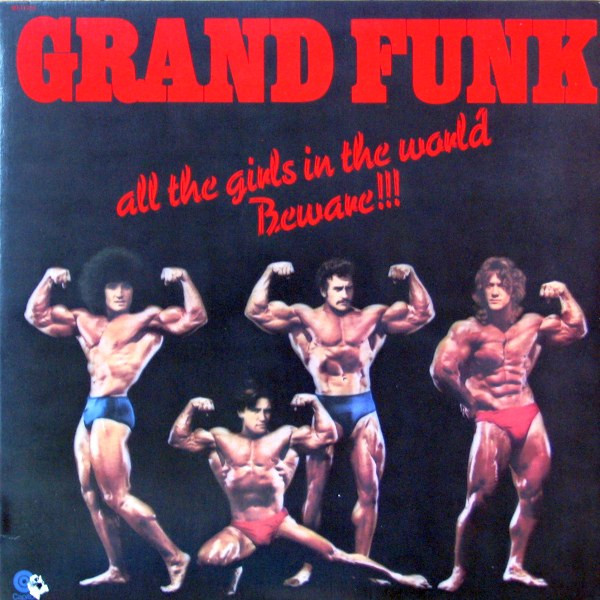
All The Girls In The World Beware !!!
 View on Discogs
Album Summary
"All The Girls In The World Beware !!!" came roaring out of Capitol Records in 1974, a time when Grand Funk Railroad was riding as high as any rock band in America. Produced by Jimmy Ienner, who had taken the production reins and helped shape the band's increasingly polished yet still hard-driving sound, the album found Mark Farner, Mel Schacher, Don Brewer, and Craig Frost locked in and firing on all cylinders. This was a band that had graduated from the underground Detroit rock circuit to selling out stadiums coast to coast, and this record captured them at that peak — confident, commercially savvy, and still carrying that blue-collar American muscle that made them one of the people's bands. Recorded and released during a period when Grand Funk was one of the biggest-drawing live acts in the country, the album stood as a testament to a band that knew exactly who they were and who they were playing for.
Reception
- The album charted on the Billboard 200, continuing Grand Funk Railroad's strong commercial run through the mid-1970s, though it did not match the stratospheric chart performance of their landmark 1973 release "We're An American Band."
- "Bad Time," lifted as a single from the album, became a notable hit and demonstrated the band's growing pop sensibility alongside their arena rock foundation.
- The record was received by fans as a solid and satisfying entry in the Grand Funk catalog, maintaining the band's arena-filling credibility and delivering exactly the kind of hard-rocking, hook-driven material their loyal audience had come to expect.
Significance
- "All The Girls In The World Beware !!!" stands as a prime example of American hard rock at the height of the stadium era — big guitars, big hooks, and a band playing with the swagger of men who had earned every seat in every arena they ever filled.
- The album reflects Grand Funk Railroad's evolution as a unit, with keyboardist Craig Frost now fully integrated into the sound, adding melodic texture and commercial depth to tracks like "Some Kind Of Wonderful" and "Bad Time" without sacrificing the raw power that built the band's reputation.
- Released in the thick of 1974, the record captures a pivotal moment in rock history when American bands were staking their claim against British rock dominance, and Grand Funk was one of the loudest voices in that conversation — a truly homegrown, working-class rock institution.
Samples
- Some Kind Of Wonderful — a cover of the Soul Brothers Six classic that became one of Grand Funk's signature moments, this track has been sampled and interpolated across multiple hip-hop and R&B productions drawn to its soulful groove and instantly recognizable melodic hook.
Tracklist
-
A1 Responsibility 118
 3:40
3:40
-
A2 Runnin' 167
4:05
-
A3 Life 171
4:56
-
A4 Look At Granny Run Run 116
2:34
-
A5 Memories 74
3:39
-
B1 All The Girls In The World Beware 142
3:23
-
B2 Wild 123
2:50
-
B3 Good & Evil —
7:34
-
B4 Bad Time 125
2:55
-
B5 Some Kind Of Wonderful 121
3:16

Artist Details
Grand Funk Railroad burst onto the scene out of Flint, Michigan in 1969, a hard-driving trio — later a quartet — that laid down a heavy, blues-soaked rock sound so raw and powerful it shook the ground beneath your feet, and while the critics tried to sleep on them, the people never did, packing arenas and selling out shows faster than any act since the Beatles. With anthems like "We're An American Band" and "I'm Your Captain," these cats proved that working-class rock and roll had a heartbeat all its own, bridging the gap between the blue-collar streets of the Midwest and the stadium stages of a nation hungry for music that spoke their truth. Grand Funk Railroad stands as one of the defining pillars of early arena rock, a testament to the fact that the real power of music was never about critical approval — it was always about the people who felt it in their bones.