I Heard That!!
 View on Discogs
 View on Wikipedia
Album Summary
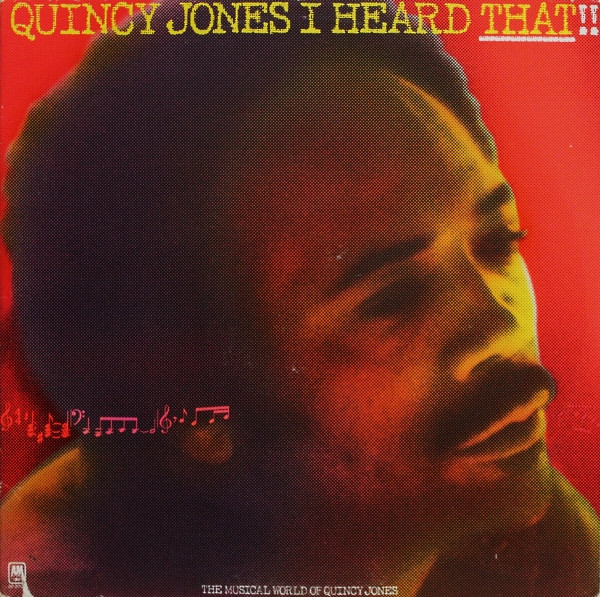
Quincy Jones dropped 'I Heard That!!' on A&M Records in 1976, and baby, this was a double album that felt like a celebration and a statement all at once. Produced by Quincy himself, this record was conceived as a retrospective of his own catalog reimagined and refreshed, blending newly recorded material with revisited arrangements that showcased the full breadth of his genius — from lush orchestral soul to hard-grooving funk. With his regular stable of elite session musicians and vocalists surrounding him in the studio, Quincy crafted something that was both a love letter to his own journey and a living, breathing document of where Black music stood in the mid-seventies. A&M had been home to some of his most commercially successful work, and this release rode that momentum with confidence and class.
Reception
- The double album format gave critics and fans a generous helping of Quincy's range, and it was broadly received as a testament to his versatility, praised for the way it moved fluidly between jazz, funk, and orchestral soul.
- Though not a blockbuster chart performer in the traditional sense, 'I Heard That!!' resonated strongly with album-oriented radio and the sophisticated soul audience that had come to trust Quincy Jones as a curator of the finest sounds.
- Critics of the era noted the album's ambition — pulling together orchestral arrangements, vocal showcases, and hard funk grooves across four sides of vinyl — as evidence that Quincy was operating on a level few producers or bandleaders could match.
Significance
- 'I Heard That!!' stands as a rare double album that documents Quincy Jones at the peak of his A&M era, capturing the full spectrum of his artistic vision — from the silky soul of 'Is It Love That We're Missin'' to the jazz muscle of 'Killer Joe' and 'Walking In Space' — making it a genuine genre-crossing monument.
- The inclusion of tracks like 'Superstition' and 'Summer In The City' alongside Quincy's own compositions demonstrated his extraordinary ability to inhabit and elevate material across styles, reinforcing his reputation as one of the most versatile musical minds of the twentieth century.
- Tracks like 'Midnight Soul Patrol' and 'Brown Soft Shoe' represent the kind of deep, sophisticated funk-jazz fusion that would prove enormously influential on the sound of urban Black music through the late seventies and into the decade that followed.
Samples
- "Killer Joe" — a deep jazz-funk groove that has been revisited and sampled across hip-hop productions over the decades, prized for its swaggering horn arrangement and locked-in rhythm section.
- "Body Heat" — sampled and interpolated by various R&B and hip-hop artists drawn to its warm, seductive mid-seventies funk atmosphere.
- "Walking In Space" — the jazz orchestration and rhythmic complexity of this track made it a source for hip-hop producers looking for sophisticated harmonic material to chop and flip.
- "Summer In The City" — Quincy's lush reimagining of this track attracted producers who mined its dense orchestral and rhythmic layers for sample fodder.
- "Is It Love That We're Missin'" — its soulful groove and vocal warmth have made it a recurring source for R&B and hip-hop producers seeking that quintessential mid-seventies Quincy feel.
Tracklist
-
A1 I Heard That!! 77
 2:18
2:18
-
A2 Things Could Be Worse For Me 115
4:35
-
A3 What Good Is A Song 124
7:29
-
A4 You Have To Do It Yourself 125
3:14
-
B1 There's A Train Leavin' 179
4:13
-
B2 Midnight Soul Patrol 113
4:12
-
B3 Brown Soft Shoe 73
4:44
-
B4 Superstition 99
3:15
-
C1 Summer In The City 81
4:18
-
C2 Is It Love That We're Missin' 104
3:54
-
C3 Body Heat 169
4:00
-
C4 If I Ever Lose This Heaven 88
3:32
-
D1 Killer Joe —
4:06
-
D2 Gula Matari 76
6:54
-
D3 Theme From "The Anderson Tapes" 126
5:06
-
D4 Walking In Space —
7:12

Artist Details
Quincy Jones is a one-of-a-kind genius out of Chicago, Illinois, a man who has been blessing our ears since the 1950s as a composer, arranger, producer, and bandleader whose fingerprints are all over jazz, soul, R&B, and pop like nobody else in the game. He came up under the wing of Ray Charles, went on to arrange for the great Count Basie and Frank Sinatra, and then turned around and produced some of the biggest records in history — including Michael Jackson's *Off The Wall* and *Thriller* — cementing himself as the architect behind sounds that moved millions of souls across generations. Quincy Jones didn't just make music; he built bridges between genres, between races, and between eras, standing tall as living proof that true artistry knows no boundaries and never goes out of style.