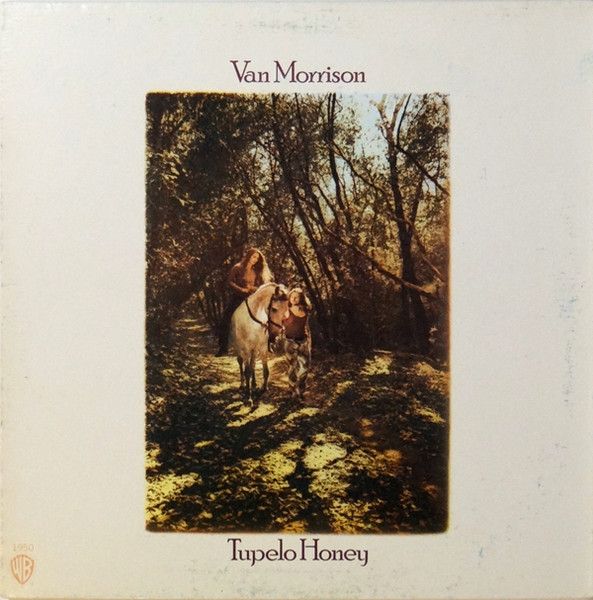
Tupelo Honey
 View on Discogs
 View on Wikipedia
Album Summary
Tupelo Honey was laid down in 1971 at the legendary Wally Heider Studios in San Francisco, and Van Morrison — a man who never needed anybody telling him how to run his session — produced the whole thing himself. Warner Bros. Records put it out in October of that year, and what came out of those studio doors was something special, something warm, something that felt less like a record and more like a Sunday morning with nowhere to be. The album draws its soul from Morrison's relationship with his then-partner Janet Planet, whose presence hangs over every groove like honeysuckle on a back porch fence. With guitarist Ronnie Montrose among the musicians helping carry the sound, Morrison crafted a record that traded the mystical fire of his earlier work for a pastoral, domestic tenderness that was entirely its own kind of magic.
Reception
- Tupelo Honey reached number 27 on the Billboard 200 in the United States, a solid and respectable showing that confirmed Morrison had a devoted audience following him wherever his muse led.
- Critics took to the album with genuine warmth, praising its relaxed, unhurried tone and Morrison's soulful vocal performances — noting with admiration how effortlessly he wove together country, soul, and folk without a single seam showing.
- The title track drew special attention from reviewers, who recognized it as one of the most tenderly romantic moments in Morrison's entire catalog — a song that didn't demand your attention so much as it simply held it.
Significance
- Tupelo Honey stands as one of the purest and most fully realized expressions of the country soul subgenre, weaving Southern American musical traditions together with Morrison's deep Celtic emotional grain in a way nobody else could have pulled off.
- The record captured something genuinely rare in the early 1970s rock landscape — an unguarded, unhurried romantic serenity — and in doing so opened a door for later artists seeking to blend rustic Americana with honest, soulful vocal expression.
- As a chapter in Van Morrison's artistic story, Tupelo Honey stands as proof that deeply personal, quietly confident songwriting — the kind that doesn't chase trends or shout for attention — can earn both lasting critical reverence and the kind of devoted audience loyalty that decades simply cannot erode.
Tracklist
-
A1 Wild Night 146
 3:29
3:29
-
A2 (Straight To Your Heart) Like A Cannonball 103
3:37
-
A3 Old Old Woodstock 146
4:14
-
A4 Starting A New Life 86
2:06
-
A5 You're My Woman 77
6:40
-
B1 Tupelo Honey 71
6:53
-
B2 I Wanna Roo You (Scottish Derivative) 150
3:22
-
B3 When That Evening Sun Goes Down 143
3:02
-
B4 Moonshine Whiskey 105
6:45

Artist Details
Van Morrison, born George Ivan Morrison in Belfast, Northern Ireland back in 1945, is one of those rare, transcendent souls who took the raw grit of rhythm and blues, wrapped it in Celtic mysticism, and created something the world had never quite heard before — from his early days fronting Them in the mid-60s to his groundbreaking solo work like Astral Weeks and Moondance, the man carved out his own sacred corner of soul, folk, and jazz that defied every category radio programmers tried to put him in. His voice — that growling, searching, deeply feeling instrument — became a touchstone for artists across generations, proving that music could be a genuine spiritual journey rather than just a product. Van Morrison's cultural significance lies in his fearless authenticity, his refusal to compromise his art for commercial trends, and his ability to make every listener feel like the music was pulling something true and ancient right up from the soul.