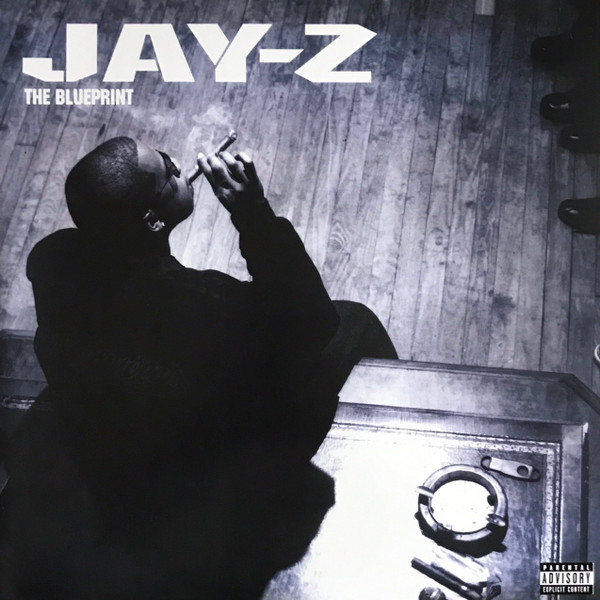
The Blueprint
 View on Discogs
 View on Wikipedia
Album Summary
Now listen here, because this one is special. The Blueprint was laid down and released on September 11, 2001 — a date the world will never forget — by Roc-A-Fella Records and Def Jam, and somehow, in the middle of all that heartbreak, this record rose up like a testament to the resilience of art itself. Jay-Z assembled a congregation of producers that reads like a who's who of the era: Kanye West, Just Blaze, Bink!, DJ Premier, and Timbaland all brought their finest work to the table, wrapping Jay's voice in lush soul samples and hard-hitting drums that felt both old-school and brand new at the same time. This wasn't just another album drop — it was a statement, a recalibration, a man stepping fully into his greatness and daring the world to argue with him.
Reception
- Debuted at number one on the Billboard 200 chart, selling over 426,000 copies in its first week — a staggering achievement given that it was released on the same day as the September 11 attacks.
- Received widespread critical acclaim, with reviewers praising the cohesion of its soul-sampling production and Jay-Z's commanding, refined lyrical presence throughout.
- Became one of Jay-Z's most celebrated and commercially successful albums, firmly establishing him as the preeminent voice in hip-hop at the dawn of a new decade.
Significance
- Marked a defining artistic peak for East Coast hip-hop in the early 2000s, proving that introspective, soulful storytelling and commercial appeal were not mutually exclusive forces.
- Served as the launchpad for Kanye West's ascent as one of the most influential producers in the history of the genre, with his soul-flipping beatcraft on this album reshaping the sonic direction of hip-hop for years to come.
- Demonstrated Jay-Z's mastery of the full emotional spectrum — from the hard-edged swagger of 'Takeover' to the aching vulnerability of 'Song Cry' — cementing his reputation as a complete artist rather than simply a hit-maker.
Samples
- Izzo (H.O.V.A.) — built around a sample of The Jackson 5's 'I Want You Back,' this track's infectious loop has itself been revisited and interpolated by numerous artists, making it one of the most recognizable sample flips in 2000s hip-hop.
- Takeover — constructed around a sample of The Doors' 'Five to One' and Nas' 'The World Is Yours,' the track's aggressive sonic palette has been sampled and referenced in subsequent rap records.
- Song Cry — rooted in a Bobby Glenn soul sample, this track's mournful, confessional production has been revisited by later artists drawn to its raw emotional weight.
- Girls, Girls, Girls — built on a layered web of samples, its playful construction has made it a reference point for producers exploring multi-sample arrangements in hip-hop.
- Renegade — produced by Eminem and featuring his legendary verse alongside Jay-Z, the track's dense, cinematic production has been sampled and interpolated in subsequent recordings.
Tracklist
-
A1 The Ruler's Back —
 3:49
3:49
-
A2 Takeover —
5:13
-
A3 Izzo (H.O.V.A.) —
4:00
-
A4 Girls, Girls, Girls —
4:35
-
B1 Jigga That Nigga —
3:24
-
B2 U Don't Know —
3:19
-
B3 Hola' Hovito —
4:33
-
B4 Heart Of The City (Ain't No Love) —
3:43
-
C1 Never Change —
3:58
-
C2 Song Cry —
5:03
-
C3 All I Need —
4:28
-
C4 Renegade —
5:37
-
D1 Blueprint (Momma Loves Me) —
-
D2 Breathe Easy (Lyrical Exercise) —
-
D3 Girls, Girls, Girls (Part 2) —

Artist Details
Jay-Z, born Shawn Carter in Brooklyn, New York in 1969, burst onto the scene in 1996 with his debut album Reasonable Doubt, building himself into one of the greatest rap empires the world has ever witnessed — blending hardcore street narratives with silky, jazz and soul-infused production that made even the smoothest cats stop and listen. This Bed-Stuy brother didn't just make records, he built a dynasty, co-founding Roc-A-Fella Records and Roc Nation, racking up 14 number-one albums, and standing toe-to-toe with business moguls in boardrooms the same way he stood tall in recording booths. Jay-Z's cultural significance runs deep — he proved that hip-hop wasn't just a sound but a language of survival, ambition, and Black excellence, elevating the genre from the streets of New York to the highest stages in the world.