Alarm Clock
 View on Discogs
 View on Wikipedia
Album Summary
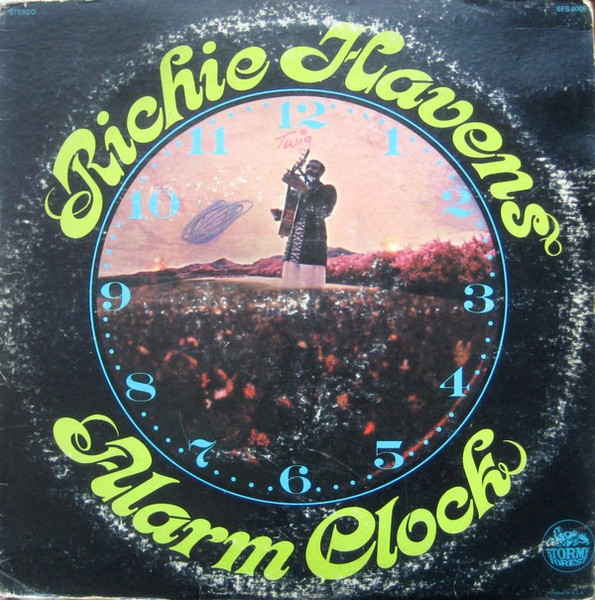
Richie Havens brought that deep, resonant soul of his straight into the studio for 'Alarm Clock,' released in 1970 on Stormy Forest Records, distributed through MGM. Produced by Ed Freeman, this record captured Havens at a moment when he was riding the spiritual momentum of a generation in motion — a man whose open-tuned guitar and throaty, searching voice had become something close to sacred to a whole lot of people. Freeman helped shape a sound that was warmer and more textured than what came before, layering Havens' raw intensity with arrangements that breathed and gave his performances room to truly live. Recorded in that fertile post-Woodstock period when the world was still trying to figure out what the '60s had meant, 'Alarm Clock' was Havens doing what he always did best — taking songs and wringing every last drop of truth out of them.
Reception
- "Alarm Clock" performed respectably on the charts, reaching the top 30 on the Billboard 200, marking one of Richie Havens' stronger commercial showings and affirming his standing as a genuine album artist in the early 1970s.
- Critics of the era responded warmly to the record, recognizing Havens' cover of George Harrison's "Here Comes The Sun" as a highlight — a reading so deeply felt that it stood on its own terms entirely.
- The album helped solidify Havens' reputation as an interpreter of rare emotional power, earning him continued respect in the folk, rock, and soul press at a time when those worlds were still in beautiful conversation with one another.
Significance
- "Alarm Clock" stands as a testament to Richie Havens' singular ability to inhabit a song completely — his treatment of "Here Comes The Sun" demonstrated that his gifts as an interpreter could elevate even the most celebrated compositions into something new and deeply personal.
- The record occupies an important place in the early 1970s folk-soul continuum, bridging the acoustic intimacy of the Greenwich Village tradition with the warmer, more produced sound that would define the singer-songwriter era just beginning to bloom.
- Tracks like "Missing Train" and the title cut "Alarm Clock" reflect Havens' grounding in African American musical and spiritual traditions, giving the album a rootedness and urgency that set it apart from the more polished folk-pop of its contemporaries.
Tracklist
-
A1 Here Comes The Sun 128
 3:43
3:43
-
A2 To Give All Your Love Away 124
2:48
-
A3 Younger Men Grow Older 128
3:34
-
A4 Girls Don't Run Away 128
4:17
-
A5 End Of The Season 128
3:38
-
B1 Some Will Wait 128
2:40
-
B2 Patient Lady 128
4:45
-
B3 Missing Train 128
4:55
-
B4 Alarm Clock 128
5:17

Artist Details
Richie Havens was a soulful, deeply spiritual folk and soul guitarist born in Brooklyn, New York, who rose to prominence in the Greenwich Village folk scene of the early 1960s and became a legend in his own right long before he ever stepped on the stage at Woodstock in 1969 — where his iconic, improvised performance of "Freedom" opened that historic festival and burned his name into the soul of a generation. His raw, rhythmic open-tuned guitar style and his voice, a force of nature that could bring a crowd to tears or its feet, set him apart from every other folksinger of his era, blending blues, gospel, and folk into something that was entirely and unmistakably his own. Richie Havens stood as a bridge between the civil rights movement and the counterculture, a man whose music carried the weight of struggle and the warmth of hope, and his legacy remains as rich and resonant today as the day those strings first rang out across half a million people in upstate New York.