Southernplayalisticadillacmuzik
 View on Discogs
 View on Wikipedia
Album Summary
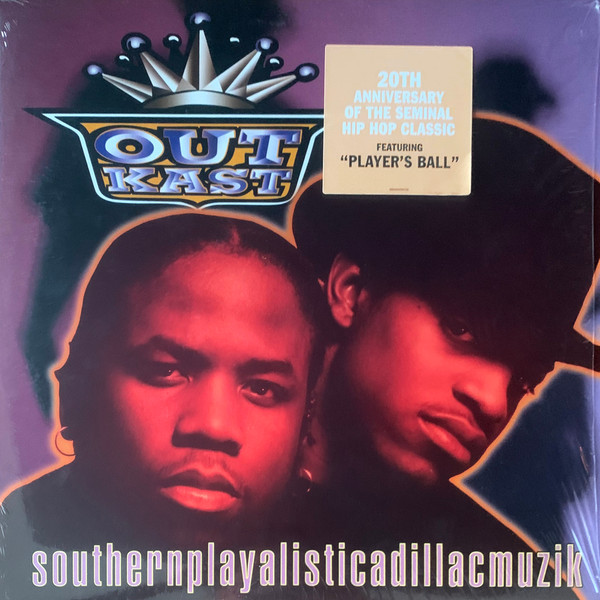
Southernplayalisticadillacmuzik came into this world on April 26, 1994, born out of the studios of Atlanta, Georgia and released through LaFace Records and Arista Records — and baby, when it hit, nothing in hip-hop was ever quite the same again. The album was produced primarily by Organized Noize, that magnificent Atlanta-based production collective who cooked up something so soulful, so steeped in the funk and blues traditions of the Black American South, that it felt less like a debut record and more like a fully realized artistic statement. At the center of it all stood two teenagers from the Atlanta suburbs — André 3000, born André Benjamin, and Big Boi, born Antwan Patton — whose lyrical chemistry had been sharpened through local talent competitions, including a fateful showcase at Club Rollin' that caught the ear of LaFace co-founder Antonio 'L.A.' Reid and set these two young men on a path toward history.
Reception
- The album debuted at number 20 on the Billboard 200 and climbed to number 3 on the Billboard Top R&B/Hip-Hop Albums chart — a stunning commercial arrival for two unknown teenagers stepping onto the national stage for the very first time.
- Critics embraced the album's richly atmospheric Southern identity and the duo's gift for vivid, narrative-driven lyricism, recognizing it as a bold and necessary counterpoint to the East and West Coast sounds that had long commanded hip-hop's mainstream conversation.
- The album earned RIAA platinum certification, surpassing one million copies sold in the United States and proving beyond any doubt that the South had not only arrived — it had come to stay.
Significance
- Southernplayalisticadillacmuzik stands as one of the foundational documents in the rise of Atlanta and the broader American South as a creatively sovereign force in hip-hop, a record that demanded the genre's coastal gatekeepers make room for something deeper, warmer, and altogether different.
- Organized Noize's production was a revelation — weaving funk, soul, and blues into the hip-hop framework in a way that felt rooted in generations of Southern Black musical tradition, laying down a template that would shape the sound of Southern rap for decades to come.
- Tracks like 'Player's Ball' and the album's title cut introduced a melodic, laid-back, and deeply narrative Southern rap aesthetic that carried the weight of real life and real place, standing in deliberate and proud contrast to the harder styles dominating the mainstream at the time.
Samples
- Player's Ball (Original) — sampled by multiple artists across hip-hop and R&B productions, recognized as one of the most musically rich source tracks to emerge from the Southern rap canon of the mid-1990s.
- Crumblin' Erb — sampled in subsequent hip-hop productions, its hazy, soulful atmosphere making it a recurring touchstone for artists drawing from the OutKast catalog.
- Git Up, Git Out — sampled and interpolated across later hip-hop recordings, its socially conscious groove lending itself to artists working in a similarly grounded, community-minded tradition.
Tracklist
-
A1 Peaches (Intro) 83
 0:51
0:51
-
A2 Ain't No Thang 177
5:23
-
A3 Welcome To Atlanta (Interlude) 115
0:58
-
A4 Southernplayalisticadillacmuzik 172
5:18
-
A5 Call Of Da Wild 177
6:06
-
A6 Player's Ball (Original) —
4:21
-
A7 Claimin' True 87
4:43
-
B1 True Dat (Interlude) 79
1:16
-
B2 Crumblin' Erb 89
5:10
-
B3 Funky Ride 144
6:31
-
B4 Git Up, Git Out 83
7:27
-
B5 Hootie Hoo 93
3:59

Artist Details
OutKast — that's André 3000 and Big Boi, baby — came out of Atlanta, Georgia in 1992 and proceeded to rewrite the rulebook on what hip-hop could be, blending Southern rap with funk, soul, psychedelia, and R&B into something that felt like the future wearing a feather boa. Their landmark albums like *Aquemini* and *Stankonia* earned them critical praise and commercial gold, and *Speakerboxxx/The Love Below* swept the Grammys in 2004, proving that two cats from the Dirty South could command the entire music world's attention. They stand as one of the most innovative and culturally significant acts to ever touch a microphone, expanding the boundaries of Black music and Southern identity in ways that still echo through every genre today.