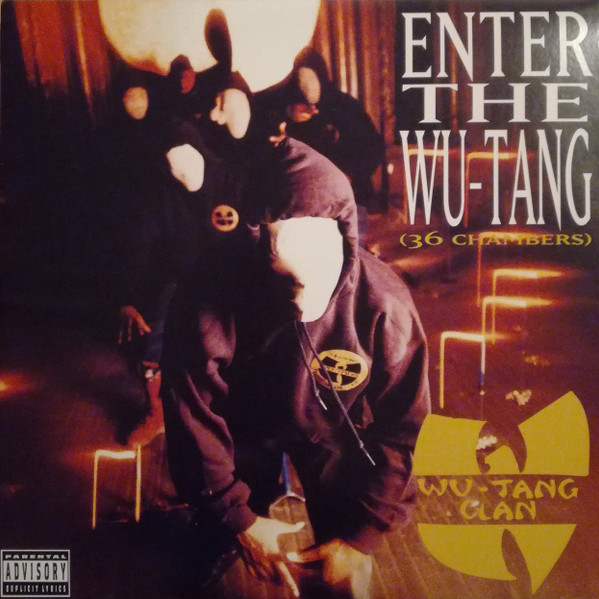
Enter The Wu-Tang (36 Chambers)
 View on Discogs
 View on Wikipedia
Album Summary
Cut deep in the trenches of Firehouse Studio in New York City, 'Enter The Wu-Tang (36 Chambers)' is the kind of record that doesn't just arrive — it crashes through the door. Released on November 9, 1993, through Loud Records and RCA, this debut masterwork from Staten Island's Wu-Tang Clan was produced almost entirely by the visionary RZA, who conjured a deliberately raw, lo-fi sonic world out of dusty soul records, kung-fu film dialogue, and hard minimalist beats that hit like a closed fist. Nine distinct voices — RZA, GZA, Ol' Dirty Bastard, Method Man, Raekwon, Ghostface Killah, Inspectah Deck, U-God, and Masta Killa — stepped out of the shadows of Staten Island and onto the national stage with an album that sounded like nothing else breathing in 1993. This wasn't just a debut record. This was a declaration.
Reception
- The album debuted at number 41 on the Billboard 200 and climbed to number 8 on the Top R&B/Hip-Hop Albums chart, eventually earning double platinum certification from the RIAA — a staggering commercial achievement for a debut rap release on an independent-leaning imprint.
- Critical reception was fierce and immediate upon release, and the reverence has only deepened with the decades, with Rolling Stone, Pitchfork, and The Source all placing it among the greatest hip-hop albums ever committed to tape.
- The single 'C.R.E.A.M.' became the album's defining anthem, reaching number 60 on the Billboard Hot 100 and number 6 on the Hot Rap Singles chart, introducing the collective's street philosophy to ears far beyond New York City.
Significance
- At a moment when West Coast gangsta rap had a firm grip on the national conversation, 'Enter The Wu-Tang (36 Chambers)' planted a flag for East Coast hip-hop with a sound and mythology so original — rooted in martial arts cinema, Five-Percent Nation theology, and unvarnished street realism — that it fundamentally shifted the cultural balance of the entire genre.
- RZA's production blueprint — chopped soul samples run through an MPC, deliberately compressed and muddied into something almost tactile — rewrote the rulebook for underground and alternative hip-hop production and left fingerprints on an entire generation of beatmakers well into the 2000s and beyond.
- By presenting nine ferociously individual lyrical voices within a single unified project, the album invented a new architecture for hip-hop collectives, proving that a rap group could operate as both a cohesive artistic statement and a launchpad for a constellation of solo careers.
Samples
- C.R.E.A.M. — one of the most sampled tracks in hip-hop history, its piano loop and atmosphere have been revisited by countless artists across multiple genres since 1993.
- Method Man — sampled and interpolated widely, its hook and production have been referenced in numerous hip-hop and R&B releases throughout the late 1990s and 2000s.
- Da Mystery Of Chessboxin' — sampled by multiple artists drawn to its percussive intensity and lyrical density, representing one of the album's most frequently lifted productions.
- Bring Da Ruckus — its hard-hitting drum patterns and sonic texture have been sampled by hip-hop producers seeking to invoke the raw energy of the Wu-Tang sound.
- Tearz — the soul sample bed woven through this track has attracted producers and artists who have drawn from its mournful, heavy atmosphere in subsequent recordings.
Tracklist
-
A1 Bring Da Ruckus 87
 4:10
4:10
-
A2 Shame On A Nigga 99
2:57
-
A3 Clan In Da Front 96
4:33
-
A4 Wu-Tang: 7th Chamber —
6:05
-
A5 Can It Be All So Simple 91
4:46
-
A6 Protect Ya Neck (Intermission) —
6:48
-
B1 Da Mystery Of Chessboxin' 103
4:48
-
B2 Wu-Tang Clan Ain't Nuthing Ta F' Wit —
3:36
-
B3 C.R.E.A.M. 92
4:12
-
B4 Method Man 103
5:50
-
B5 Tearz 92
4:17
-
B6.1 Wu-Tang: 7th Chamber - Part II —
5:08
-
B6.2 Conclusion —
1:02

Artist Details
Wu-Tang Clan burst onto the scene out of Staten Island, New York in 1992, bringing together nine fierce MCs — RZA, GZA, Ol' Dirty Bastard, Method Man, Raekwon, Ghostface Killah, Inspectah Deck, U-God, and Masta Killa — to forge a raw, cinematic strain of East Coast hip-hop built on dusty soul samples, martial arts mysticism, and street poetry that hit the ears like nothing before it. Their 1993 debut Enter the Wu-Tang (36 Chambers) didn't just shake up rap — it rewired the whole game, proving that a collective of independent voices could move as one unstoppable force while also launching a flood of legendary solo careers. They stand today as one of the most influential groups in the history of hip-hop, having shaped the sound, the business model, and the very culture of an entire generation.