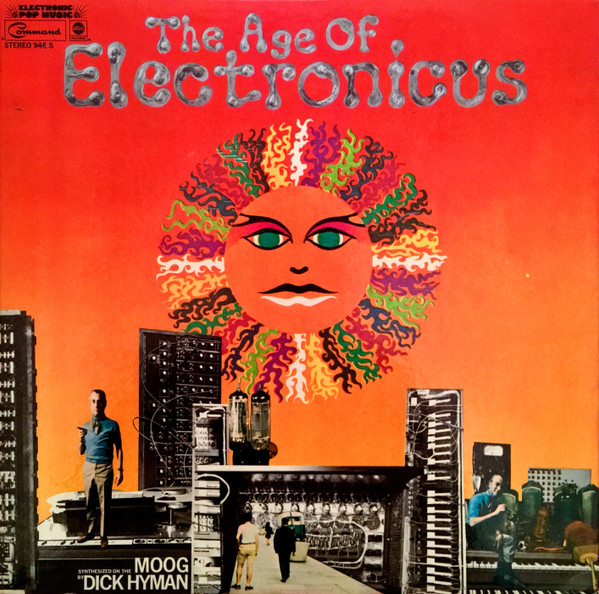
Moog - The Electric Eclectics Of Dick Hyman
 View on Discogs
Album Summary
Recorded at the tail end of the 1960s and released in 1969 on Command Records, 'Moog - The Electric Eclectics Of Dick Hyman' arrived right in the thick of the synthesizer revolution that was reshaping what people thought music could even be. Dick Hyman, a man whose musical mind had already roamed jazz, classical, and pop with equal authority, stepped into the studio and wrapped his hands and imagination around the Moog synthesizer with the confidence of a seasoned craftsman picking up a strange and beautiful new tool. The album was produced with an ear toward both experimentation and accessibility, letting Hyman's compositional personality shine through tracks that ranged from the playfully exotic to the genuinely avant-garde, and it stands as one of the more musically serious American entries into the early synthesizer canon.
Reception
- The album was embraced by adventurous listeners and critics who saw it as a bold and playful exploration of the Moog synthesizer's potential, arriving at a moment when the instrument was still a novelty to most ears.
- It did not make mainstream chart waves, but it earned serious attention in electronic and avant-garde music circles as a demonstration of what a classically trained jazz musician could do when handed a machine from the future.
- Critics noted that Hyman brought a musicianship and wit to the Moog that separated this record from the novelty synth cash-ins flooding the market in the wake of Switched-On Bach.
Significance
- "The Minotaur" became the album's most electrifying moment and a landmark in early synthesizer music, showcasing the Moog's capacity for raw, driving energy rather than just atmospheric curiosity.
- The album as a whole represents one of the earliest and most musically sophisticated American explorations of the Moog synthesizer, predating the full commercial wave and rooted in genuine compositional craft rather than gimmickry.
- Hyman's approach on tracks like 'Four Duets In Odd Meter' and 'Improvisation In Fourths' demonstrated that the synthesizer could carry serious jazz and classical sensibilities, helping to legitimize the instrument as a vehicle for real musical thought.
Samples
- "The Minotaur" — one of the most sampled tracks in early hip-hop and electronic music history, with its thunderous Moog bassline appearing in a vast number of productions across decades, making it arguably the most recognizable sample from any early synthesizer recording.
Tracklist
-
A1 The Topless Dancers Of Corfu —
 3:01
3:01
-
A2 The Legend Of Johnny Pot 123
2:04
-
A3 The Moog And Me 105
3:00
-
A4 Tap Dance In The Memory Banks 96
2:30
-
A5 Four Duets In Odd Meter 135
4:28
-
B1 The Minotaur 62
8:26
-
B2 Total Bells And Tony 108
2:01
-
B3 Improvisation In Fourths 80
2:24
-
B4 Evening Thoughts 91
3:20

Artist Details
Dick Hyman is a true cats cat, a New York City-born jazz pianist and organist extraordinaire who came up in the post-war era of the late 1940s and never stopped swinging, becoming one of the most versatile and prolific session musicians and arrangers in the whole game. This man could float effortlessly from straight-ahead bebop to stride piano to the funkiest electric organ grooves, lending his genius to everything from pop recordings and film scores to serious jazz albums, making him an indispensable force in both the commercial and artistic worlds of American music. His deep reverence for the history of jazz, particularly his celebrated explorations of early jazz and ragtime styles, made him not just a performer but a living bridge between the roots of the music and its ever-evolving present.