
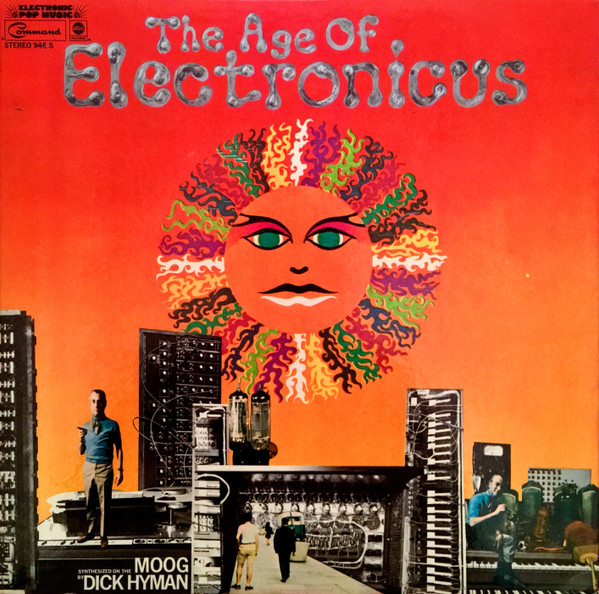
The Age Of Electronicus
 View on Discogs
 View on Wikipedia
Album Summary
Dick Hyman, one of the most versatile and forward-thinking keyboard cats to ever walk into a studio, stepped into genuinely uncharted territory with 'The Age Of Electronicus,' released in 1969 on Command Records. Hyman — a man whose hands had touched everything from jazz to classical to pop — turned to the Moog synthesizer at a moment when most musicians were still trying to figure out what that wild machine even was. Produced with the clinical precision and adventurous spirit that Command Records was known for during its high-fidelity heyday, this record captured Hyman interpreting the sounds of the moment — Beatles cuts, soul grooves, pop standards — through the buzzing, oscillating voice of early electronic synthesis. It was a studio document of a man genuinely curious about where technology and music were headed, laid down at a time when the whole world felt like it was tilting into the future.
Reception
- The album was received as a novelty curiosity by some corners of the press, yet serious listeners recognized Hyman's musicianship elevating the Moog beyond gimmickry into something with genuine interpretive soul.
- Command Records marketed the album toward the hi-fi audiophile crowd as well as the pop-curious listener, giving it broader shelf presence than a strictly jazz release might have earned.
- Critical response acknowledged the timeliness of the record — arriving in the same cultural moment as other Moog-forward releases — positioning Hyman as a credible voice in the early electronic music conversation.
Significance
- The Age Of Electronicus stands as an early and serious document of the Moog synthesizer being applied to contemporary popular repertoire, bridging the gap between the emerging electronic music world and the mainstream pop and soul songs that everyday listeners already loved — tracks like 'Ob-La-Di, Ob-La-Da,' 'Aquarius,' and 'Green Onions' given a whole new electric skin.
- Hyman's treatment of soul and funk material — particularly 'Give It Up Or Turn It Loose' and 'Time Is Tight' — demonstrated that the synthesizer could carry rhythmic heat and emotional weight, not just cold scientific curiosity, a notion that would prove prophetic for decades of music to come.
- The album exists as a cultural time capsule of 1969, a year when the boundaries between acoustic tradition and electronic experimentation were dissolving in real time, and Dick Hyman was one of the few musicians with the classical chops and jazz instincts to navigate that crossing with genuine authority.
Samples
- Green Onions — Hyman's electronic rendering of the Booker T. & the MG's classic has been noted among the versions of this widely sampled standard drawn upon by hip-hop and electronic producers seeking a more otherworldly texture.
- Time Is Tight — the Booker T. & the MG's original of this track has a deep sampling legacy, and Hyman's Moog interpretation has been identified as a source used by producers in search of that distinctive synthesized low-end groove.
Tracklist
-
A1 Ob-La-Di, Ob-La-Da 85
 2:42
2:42
-
A2 Give It Up Or Turn It Loose 126
3:09
-
A3 Blackbird 65
3:09
-
A4 Aquarius 168
2:45
-
A5 Green Onions 136
7:48
-
B1 Kolumbo —
7:34
-
B2 Time Is Tight —
3:07
-
B3 Alfie 69
3:38
-
B4 Both Sides Now —
2:58

Artist Details
Dick Hyman is a true cats cat, a New York City-born jazz pianist and organist extraordinaire who came up in the post-war era of the late 1940s and never stopped swinging, becoming one of the most versatile and prolific session musicians and arrangers in the whole game. This man could float effortlessly from straight-ahead bebop to stride piano to the funkiest electric organ grooves, lending his genius to everything from pop recordings and film scores to serious jazz albums, making him an indispensable force in both the commercial and artistic worlds of American music. His deep reverence for the history of jazz, particularly his celebrated explorations of early jazz and ragtime styles, made him not just a performer but a living bridge between the roots of the music and its ever-evolving present.


