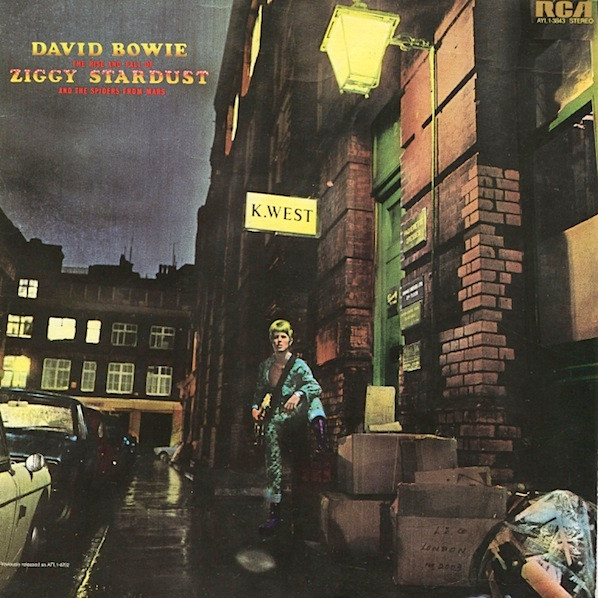
The Rise And Fall Of Ziggy Stardust And The Spiders From Mars
 View on Discogs
 View on Wikipedia
Album Summary
Recorded at Trident Studios in London between July and November 1971, 'The Rise and Fall of Ziggy Stardust and the Spiders from Mars' came roaring out of RCA Records on June 16, 1972 — and honey, the world was never quite the same after that. Produced by David Bowie and the masterful Ken Scott, this record was the sound of a man who didn't just write a character, he *became* one. Ziggy Stardust, the doomed alien rock messiah, arrived fully formed and blazing, backed by the Spiders from Mars — Mick Ronson on guitar, Trevor Bolder on bass, and Mick Woodmansey on drums — a band that delivered a raw, hard-driving glam rock thunder that made every groove on this record feel like it was being played at the end of the world. This wasn't just an album. This was a ceremony.
Reception
- Upon release, the album climbed to number 5 on the UK Albums Chart, marking the commercial breakthrough that Bowie had been building toward through years of restless artistic searching.
- Critics embraced it with open arms, lavishing praise on its cohesive storytelling, Mick Ronson's searing guitar work, and Bowie's fearless vocal performances — and the decades since have only deepened that reverence, with the album earning a place on Rolling Stone's list of the greatest albums of all time.
- The theatrical Ziggy Stardust Tour transformed the record into a full-blown cultural event, sustaining its chart presence and turning Bowie's audience into true believers long after that initial release date.
Significance
- This album stands as one of the towering monuments of glam rock, fusing androgyny, science fiction mythology, and hard rock electricity in a way that shook loose the conventions of gender and identity that pop music had long taken for granted.
- Ziggy Stardust himself became one of the most powerful and enduring alter egos in the history of rock and roll, lighting a torch that would be carried forward by generations of artists — from the punk and new wave movements all the way through to performers like Lady Gaga and Marilyn Manson — who understood that a constructed persona could be its own kind of truth.
- With its interwoven themes of fame, self-destruction, and messianic stardom, the album achieved a conceptual weight that lifted it far above the ordinary rock release of its era, securing its permanent place as a landmark in art rock and the broader story of popular music.
Samples
- Suffragette City — one of the most recognizable riffs on the album, sampled and interpolated across rock and hip-hop contexts over the decades, with its raw energy and signature piano line drawing repeated attention from producers.
- Starman — interpolated and referenced by various artists across pop and electronic music, with its melodic hook proving irresistible to those mining the Bowie catalog for source material.
- Ziggy Stardust — sampled and referenced in hip-hop and alternative contexts, with the track's guitar-driven identity making it one of the more frequently revisited cuts from the record.
Tracklist
-
A1 Five Years 152
 4:42
4:42
-
A2 Soul Love 74
3:34
-
A3 Moonage Daydream 144
4:40
-
A4 Starman 103
4:10
-
A5 It Ain't Easy 133
2:58
-
B1 Lady Stardust 128
3:22
-
B2 Star 138
2:47
-
B3 Hang On To Yourself 89
2:40
-
B4 Ziggy Stardust 80
3:13
-
B5 Suffragette City 144
3:25
-
B6 Rock 'N' Roll Suicide 103
2:58

Artist Details
David Bowie was a one-of-a-kind visionary who came out of Brixton, London in the late 1960s and spent the next decade rewriting every rule in the book — glam rock, art rock, soul, funk, you name it, that man could do it all and make it look like it was always supposed to be that way. With his shape-shifting personas like Ziggy Stardust and the Thin White Duke, Bowie didn't just make music, he created entire worlds that gave permission to every misfit and dreamer out there to be exactly who they were. His influence stretches so deep and so wide that you can hear Bowie's fingerprints on just about everything that came after him, and the music industry, the fashion world, and pop culture as a whole are forever changed because this man walked through it.