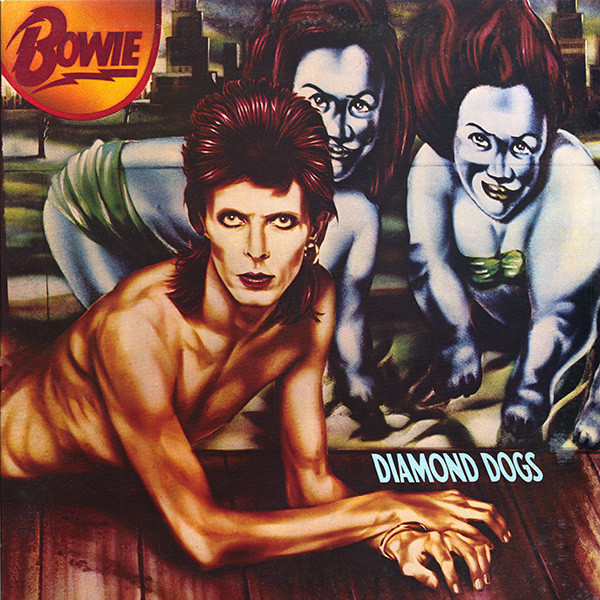
Diamond Dogs
 View on Discogs
 View on Wikipedia
Album Summary
Recorded in 1973 and delivered to the world in May of 1974 on RCA Records, Diamond Dogs stands as one of the most audacious creative swings David Bowie ever took. Produced by Bowie himself alongside Ken Scott, this record was born out of an ambitious attempt to bring George Orwell's dystopian novel 1984 to the stage — a plan that ultimately shifted into something even more powerful: a full-blown concept album dripping with post-apocalyptic dread, carnival menace, and raw, gritty rock and roll. With Bowie stepping fully into the role of guitarist for the first time and the Spiders From Mars now gone, Diamond Dogs marked the dawn of a new and dangerous chapter in the man's ever-evolving sonic journey.
Reception
- Diamond Dogs climbed to number 1 on the UK Albums Chart and reached number 5 on the Billboard 200 in the United States, cementing Bowie's commercial dominance on both sides of the Atlantic.
- The title track 'Diamond Dogs' broke into the top 10 in multiple countries, proving that Bowie's darker, harder-edged direction resonated deeply with the record-buying public.
- Critics lauded the album's theatrical ambition and conceptual boldness, recognizing it as a fearless artistic statement from an artist who refused to stand still.
Significance
- Diamond Dogs represents a seismic shift in Bowie's artistic trajectory, pulling him away from the glam rock glitter of his Ziggy years and steering him toward the art rock and experimental territories he would continue to explore throughout the decade.
- The album's deeply dystopian narrative framework — rooted in Orwellian imagery and post-civilizational dread — helped expand what a rock concept album could be, influencing a generation of artists who dared to think beyond the three-minute single.
- Diamond Dogs laid the philosophical and aesthetic groundwork for Bowie's theatrical approach to live performance, most visibly realized in the elaborate Diamond Dogs Tour of 1974, one of the most ambitious stage productions rock music had ever seen.
Samples
- "Diamond Dogs" — sampled by various hip-hop and electronic artists drawn to its menacing guitar riff and dystopian atmosphere, making it one of the more recognizable touchstones from the album in sample culture.
- "Sweet Thing" — sampled for its lush, melancholic orchestration, with its haunting sonic palette attracting producers seeking cinematic, emotionally rich source material.
Tracklist
-
A1 Future Legend 121
 1:00
1:00
-
A2 Diamond Dogs 122
5:50
-
A3 Sweet Thing 119
3:29
-
A4 Candidate 129
2:39
-
A5 Sweet Thing (Reprise) 122
2:32
-
A6 Rebel Rebel 125
4:21
-
B1 Rock 'N Roll With Me —
3:54
-
B2 We Are The Dead 138
4:48
-
B3 1984 117
3:24
-
B4 Big Brother 180
3:25
-
B5 Chant Of The Ever Circling Skeletal Family 139
1:48

Artist Details
David Bowie was a one-of-a-kind visionary who came out of Brixton, London in the late 1960s and spent the next decade rewriting every rule in the book — glam rock, art rock, soul, funk, you name it, that man could do it all and make it look like it was always supposed to be that way. With his shape-shifting personas like Ziggy Stardust and the Thin White Duke, Bowie didn't just make music, he created entire worlds that gave permission to every misfit and dreamer out there to be exactly who they were. His influence stretches so deep and so wide that you can hear Bowie's fingerprints on just about everything that came after him, and the music industry, the fashion world, and pop culture as a whole are forever changed because this man walked through it.