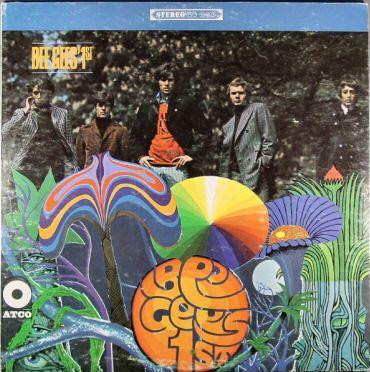
Bee Gees' 1st
 View on Discogs
 View on Wikipedia
Album Summary
Bee Gees' 1st is the debut album from the Bee Gees, released in 1967 on Atco Records in the United States and Polydor internationally. The record was produced by Ossie Byrne, capturing the brothers Barry, Robin, and Maurice Gibb at the very beginning of their professional journey — a group that had been honing their craft in Australia before making the bold move back to England to chase the dream. The album was shaped during a period when the British Invasion had redefined pop music worldwide, and the Bee Gees arrived with something that felt both familiar and utterly their own — lush vocal harmonies, melodic sophistication, and a songwriting sensibility well beyond their years. This was not a rough draft. This was a statement.
Reception
- Lead single 'New York Mining Disaster 1941' became an international breakthrough hit, reaching the top 40 in both the United States and the United Kingdom and announcing the Bee Gees as a serious force in pop music.
- 'To Love Somebody,' released as a follow-up single, further cemented the album's commercial presence and would go on to become one of the most enduring songs in the Bee Gees' entire catalog.
- The album earned the group recognition in both Australia and the UK, establishing a transatlantic profile that laid the groundwork for their remarkable career to come.
Significance
- Bee Gees' 1st marked the formal introduction of one of popular music's most gifted sibling acts, showcasing the three-part vocal harmonies that would become the group's most identifiable and beloved trademark across every era of their work.
- Released at the height of the late 1960s pop explosion, the album demonstrated that the Bee Gees were not merely riding a cultural wave but were genuine songwriters capable of crafting emotionally resonant material — a distinction that separated them from many of their contemporaries.
- The record stands as the artistic foundation of a career that would span decades and genres, proving that the sophistication and melodic intelligence heard on tracks like 'To Love Somebody' and 'Holiday' were never accidental — they were always in the Gibb brothers' DNA.
Samples
- "To Love Somebody" — one of the most covered and interpolated songs from the album, with its chord structure and melodic phrasing influencing and appearing in numerous recordings across genres over the decades.
Tracklist
-
A1 Turn Of The Century 127
 2:24
2:24
-
A2 Holiday 104
2:52
-
A3 Red Chair, Fade Away 104
2:16
-
A4 One Minute Woman 94
2:14
-
A5 In My Own Time 127
2:12
-
A6 Every Christian Lion Hearted Man Will Show You 94
3:32
-
A7 Craise Finton Kirk Royal Academy Of Arts 121
2:15
-
B1 New York Mining Disaster 1941 87
2:09
-
B2 Cucumber Castle 81
2:02
-
B3 To Love Somebody 90
2:58
-
B4 I Close My Eyes 109
2:19
-
B5 I Can't See Nobody 203
3:43
-
B6 Please Read Me 91
2:13
-
B7 Close Another Door 118
3:22

Artist Details
The Bee Gees were a brilliant trio of brothers — Barry, Robin, and Maurice Gibb — who first came together in Brisbane, Australia in the late 1950s before hitting the British Invasion scene hard in the mid-1960s, blending lush harmonies and melodic pop into something that was purely their own. These cats went through more reinventions than most artists could dream of, riding high on soulful ballads before transforming into the undisputed kings of disco with their electrifying soundtrack to Saturday Night Fever in 1977 — an album so massive it practically redefined what pop music could do on a global scale. From the sweet vulnerability of their falsetto vocals to those shimmering, danceable grooves, the Bee Gees left a fingerprint on the music world that stretched across generations, earning them a place among the best-selling music acts in history and a rightful seat in the Rock and Roll Hall of Fame.