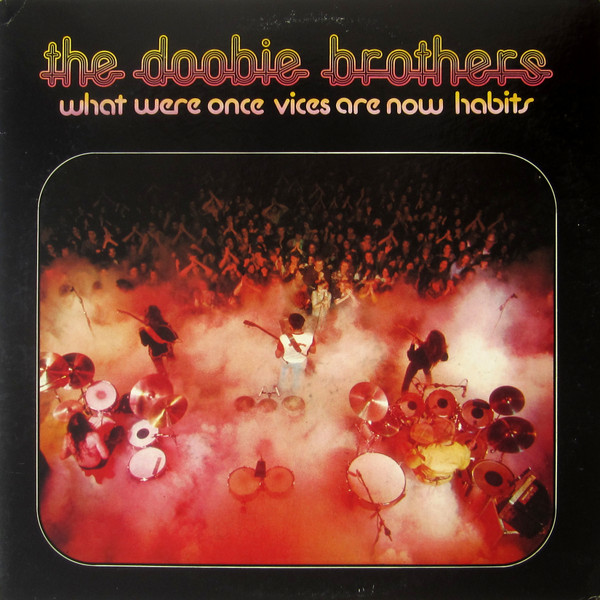
What Were Once Vices Are Now Habits
 View on Discogs
 View on Wikipedia
Album Summary
"What Were Once Vices Are Now Habits" came roaring out of the Warner Bros. Records stable in 1974, the fourth studio album from those hard-driving, harmony-drenched cats known as The Doobie Brothers. Produced by the masterful Ted Templeman, who had locked in as the band's sonic architect and trusted guide, this record captured a group that was firing on all cylinders — blending rock, soul, and country into something that felt both effortless and urgent. Recorded during a stretch when the Doobies were tightening their grip on the American rock landscape, the album stands as a testament to what happens when a band finds its groove and refuses to let go.
Reception
- The album climbed all the way to No. 1 on the Billboard 200, marking the first time The Doobie Brothers had claimed the top spot on the album chart.
- "Black Water" emerged as the album's crown jewel single, rising to No. 1 on the Billboard Hot 100 and becoming the band's first and only chart-topper on that singles survey.
- The album was certified multi-platinum, standing as one of the most commercially triumphant releases in The Doobie Brothers' storied catalog.
Significance
- "Black Water" became an FM radio institution, its rolling rhythms and gorgeous vocal interplay embodying everything that made the Doobie Brothers one of the defining acts of 1970s American rock.
- The album represents a high-water mark in the band's ability to fuse rock muscle with soulful warmth and country tenderness — a balancing act few of their contemporaries could pull off with such natural authority.
- With this record, The Doobie Brothers proved themselves not just as hitmakers but as genuine craftsmen, delivering an album that held together as a full listening experience from the opening notes of "Song To See You Through" all the way through to "Flying Cloud."
Samples
- "Black Water" — one of the most recognized and referenced rock tracks of the 1970s, with a sampling and interpolation legacy that has extended well into hip-hop and contemporary music culture.
Tracklist
-
A1 Song To See You Through 102
 4:06
4:06
-
A2 Spirit 120
3:15
-
A3 Pursuit On 53rd St. 136
2:33
-
A4 Black Water 172
4:17
-
A5 Eyes Of Silver 112
2:57
-
A6 Road Angel 123
4:49
-
B1 You Just Can't Stop It 102
3:28
-
B2 Tell Me What You Want And I'll Give You What You Need —
3:53
-
B3 Down In The Track 129
4:15
-
B4 Another Park Another Sunday —
4:27
-
B5 Daughters Of The Sea 148
4:29
-
B6 Flying Cloud 139
2:00

Artist Details
The Doobie Brothers are a rock and roll institution that came together in San Jose, California back in 1970, blending rock, R&B, and soul into a sound so smooth and funky it could slide right between the AM and FM dial without missing a beat. With classic grooves like Listen to the Music and What a Fool Believes, these cats proved that a band could have multiple lead singers, swap styles, and still keep the people on their feet through the entire decade. Their staying power and ability to evolve — especially when Michael McDonald joined and took that blue-eyed soul to another level — made the Doobie Brothers one of the defining acts of the 1970s and a living testament to American rock music at its most soulful and inventive.