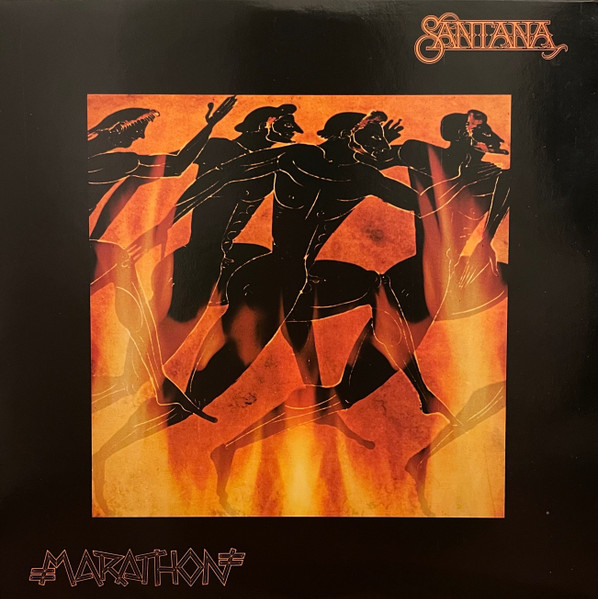
Marathon
 View on Discogs
 View on Wikipedia
Album Summary
Marathon came rolling out of Columbia Records in 1979, the product of Carlos Santana and his band pushing deeper into the sleek, polished sound they had been sculpting throughout the latter half of that decade. Produced by Santana alongside keyboard maestro Tom Coster, the album was built in the studio with a clear eye on the contemporary landscape — funk grooves, R&B textures, and that unmistakable Latin fire all woven together into something that was undeniably of its time. It was a band in motion, never standing still, always chasing the next horizon even as the music world around them was shifting beneath their feet.
Reception
- Marathon reached #16 on the Billboard 200, a solid showing that confirmed Santana still had the ears of a devoted and wide-reaching audience deep into the album rock era.
- The single 'You Know That I Love You' received moderate radio airplay, giving the album a commercial foothold on the charts.
Significance
- Marathon stands as a vivid document of Santana's late-1970s artistic evolution, demonstrating how Carlos and the band were stretching their Latin-rock roots to embrace the funk, soul, and R&B currents running through popular music at the close of the decade.
- The album reflects the band's determination to remain a living, breathing force in a music industry undergoing seismic stylistic shifts — from the fading disco wave to the rising tide of new wave and arena rock.
- With tracks like 'Stand Up' and 'Runnin',' Marathon captures a band that never treated their legacy as a resting place, always willing to experiment and push the sound forward even when the critical establishment had its eyes turned elsewhere.
Tracklist
-
A1 Marathon 134
 1:27
1:27
-
A2 Lightning In The Sky 126
3:51
-
A3 Aqua Marine 175
5:37
-
A4 You Know That I Love You 127
4:27
-
A5 All I Ever Wanted 136
4:01
-
B1 Stand Up 131
4:03
-
B2 Runnin' —
1:40
-
B3 Summer Lady 121
4:22
-
B4 Love 119
3:22
-
B5 Stay (Beside Me) 119
3:50
-
B6 Hard Times 135
3:58

Artist Details
Santana is a rock band formed in San Francisco, California in 1966, led by Mexican-American guitarist Carlos Santana, who immigrated from Autlán de Navarro, Mexico. The group pioneered a distinctive sound that fused rock, blues, and jazz with Afro-Cuban and Latin rhythms, creating a genre-blending style that set them apart from virtually every other act of their era. Their legendary performance at the 1969 Woodstock Festival introduced them to a massive worldwide audience, and their debut album released that same year became a commercial and critical success. Santana experienced a major commercial resurgence in 1999 with the album Supernatural, which won nine Grammy Awards including Album of the Year and became one of the best-selling albums in history. Culturally, Santana holds profound significance as a symbol of Latin musical influence in mainstream American rock, helping to bridge cultures and pave the way for broader acceptance of Latin artists in the global music industry.