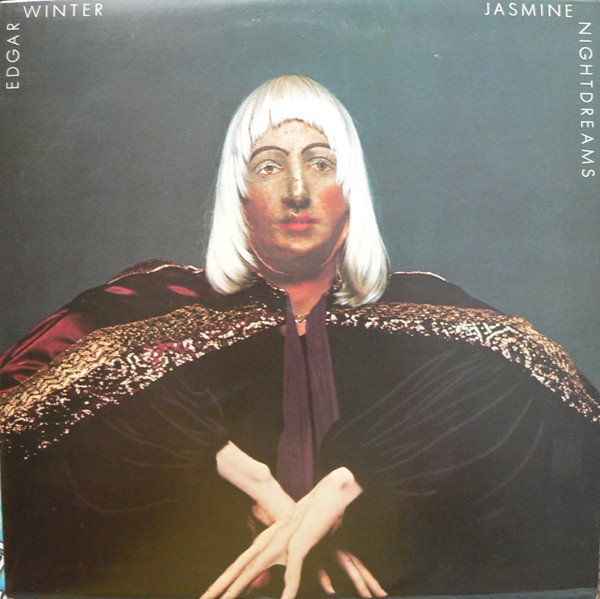
Jasmine Nightdreams
 View on Discogs
 View on Wikipedia
Album Summary
Jasmine Nightdreams arrived in 1975 on Blue Sky Records, the Columbia Records subsidiary that Edgar Winter had made his musical home, and from the first groove it was clear this was not the same cat who had rocked the arenas with the Edgar Winter Group. Produced during a period of genuine artistic soul-searching, Winter stepped back from the hard rock thunder and let his deeper musical instincts breathe — weaving together jazz, funk, soul, and pop into something warm, sophisticated, and altogether unexpected. The record put Winter's extraordinary multi-instrumental gifts front and center, showcasing his keyboards, saxophone, and vocals in lush, lounge-kissed arrangements that felt less like a rock album and more like a late-night conversation with a musician who had something new and honest to say.
Reception
- Jasmine Nightdreams drew a mixed critical response upon release, with admirers celebrating Winter's remarkable versatility while detractors found the stylistic pivot away from blues-rock too jarring and too far removed from what had built his commercial following.
- The album underperformed at retail relative to Winter's earlier successes, failing to generate a breakout single and landing only modest chart numbers — a commercial reality that stood in contrast to the genuine artistic ambition behind the project.
- A measure of critical generosity did emerge, with some reviewers recognizing the record as a bold and sophisticated artistic statement, crediting Winter for refusing to simply repeat himself when the safer, more profitable path was right there in front of him.
Significance
- Jasmine Nightdreams occupies a genuinely singular place in Edgar Winter's catalog — a record that proved he was an artist first and a rock star second, unwilling to be boxed in by genre or market expectation at a moment when the industry was pushing harder than ever for artists to stay in their lanes.
- The album plants Winter firmly within the mid-1970s movement of rock artists reaching across the aisle toward jazz fusion and soul, placing him in the company of a generation of musicians who understood that the most exciting music lived somewhere between the categories.
- Decades on, Jasmine Nightdreams has earned a devoted cult following among lovers of 1970s jazz-pop and soft soul crossover music, celebrated for its rich arrangements and the kind of expressive, unhurried instrumental performances that only reveal their full beauty over time and repeated listening.
Tracklist
-
A1 One Day Tomorrow —
 3:10
3:10
-
A2 Little Brother —
4:08
-
A3 Hello Mellow Feelin' —
2:47
-
A4 Tell Me In A Whisper —
3:25
-
A5 Shuffle-Low —
4:20
-
A6 Keep On Burnin' —
4:12
-
B1 How Do You Like Your Love —
3:03
-
B2 I Always Wanted You —
3:21
-
B3 Outa Control —
4:09
-
B4 All Out —
-
B5 Sky Train —
-
B6 Solar Strut —
12:37

Artist Details
Edgar Winter, the albino Texas-born multi-instrumentalist and brother of blues legend Johnny Winter, burst onto the scene in the early 1970s with his Edgar Winter Group, blending rock, blues, jazz, and funk into a sound so electric it could light up a stadium — and that 1972 monster instrumental "Frankenstein" proved it, hitting number one and becoming one of the first rock songs to feature a synthesizer as a lead instrument. Coming out of Beaumont, Texas and cutting his teeth alongside his brother before launching his own outfit, Edgar brought a wild, fearless energy to progressive rock that made him a fixture on album-oriented radio and a genuine innovator whose keyboard-and-saxophone sorcery left a permanent mark on the sound of the decade.