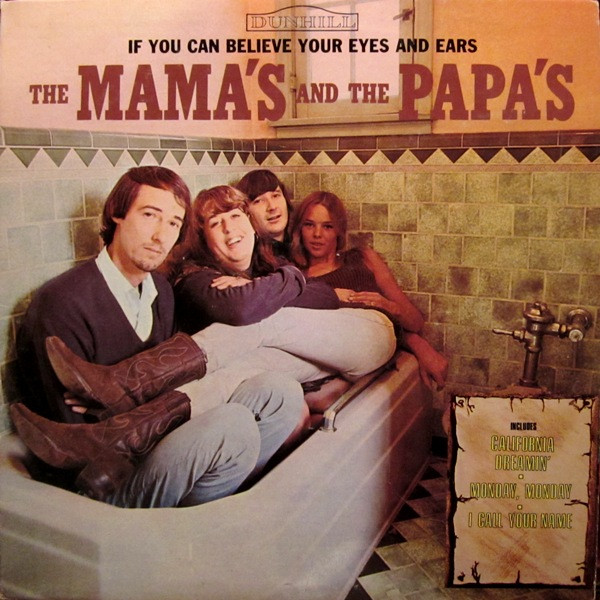
If You Can Believe Your Eyes And Ears
 View on Discogs
Album Summary
Recorded in the closing months of 1965 at Western Recorders in Hollywood and released in January 1966 on Dunhill Records, 'If You Can Believe Your Eyes and Ears' was the debut album from The Mamas & the Papas — John Phillips, Denny Doherty, Cass Elliot, and Michelle Phillips — produced by the masterful Lou Adler. The group had come up from the Virgin Islands and landed in Los Angeles with something special burning inside them, and Adler had the ears and the instincts to capture it. What came out of those sessions was a record drenched in warmth — lush four-part harmonies riding on top of polished, carefully arranged pop production that felt like sunshine and longing all at once. Phillips's songwriting and Adler's studio command made for a combination that was simply undeniable, and the result was one of those rare debut albums that arrived fully formed, like it had always existed and the world was just now catching up to it.
Reception
- The album climbed all the way to number one on the Billboard 200 in 1966, announcing The Mamas & the Papas as a dominant force in the emerging Los Angeles pop scene and one of the most important American groups of their era.
- The single 'California Dreamin'' reached number four on the Billboard Hot 100, becoming a cultural touchstone and one of the defining songs of the decade while powering the album's extraordinary commercial run.
- Critics embraced the album's seamless fusion of folk sensibility and polished pop craft, recognizing it immediately as a landmark work of mid-1960s American music.
Significance
- 'If You Can Believe Your Eyes and Ears' stands as one of the cornerstone documents of the mid-1960s California Sound, a record that helped pull the spotlight of popular music back from the British Invasion and place it squarely on the sun-soaked hills of Los Angeles.
- 'California Dreamin'' transcended its moment to become an enduring symbol of escapism and restless longing, planting seeds for the counterculture movement that would fully flower across the rest of the decade.
- The album's sophisticated four-part vocal harmonies set a new standard for ensemble pop singing in America, laying foundational groundwork for the harmony-rich Laurel Canyon sound that would define a generation of artists in the years to come.
Samples
- Monday, Monday — sampled by numerous hip-hop and R&B producers over the decades, with its vocal hook and arrangement proving particularly attractive to sample-based artists seeking that golden mid-60s warmth.
- California Dreamin' — one of the most recognized songs of its era, the track has been interpolated and sampled across multiple genres, perhaps most notably carried into a new generation through its prominent use in the 1994 film Chungking Express and subsequent cultural revivals.
Tracklist
-
A1 Monday, Monday 109
 3:03
3:03
-
A2 Straight Shooter 119
2:55
-
A3 Got A Feelin' 99
2:44
-
A4 I Call Your Name 111
2:32
-
A5 Do You Wanna Dance 108
2:58
-
A6 Go Where You Wanna Go 210
2:32
-
B1 California Dreamin' 112
2:32
-
B2 Spanish Harlem 72
3:22
-
B3 Somebody Groovy 116
3:06
-
B4 Hey Girl 113
2:21
-
B5 You Baby 122
2:15
-
B6 In Crowd —
3:10

Artist Details
The Mamas & The Papas were a dream-woven folk-pop vocal group that came together in Los Angeles in 1965, blending the voices of John Phillips, Denny Doherty, Cass Elliot, and Michelle Phillips into some of the most lush, harmonically rich sounds the decade ever produced — hits like "California Dreamin'" and "Monday Monday" became the very soundtrack of a generation searching for sunshine and freedom. They stood right at the crossroads of the folk revival and the psychedelic pop explosion, helping to bridge those worlds with an elegance that few could match, and their influence on West Coast sound and the whole spirit of the counterculture runs deeper than most folks ever stop to appreciate. Though their run was tragically short, burning bright from 1965 to 1968, the music they left behind carries the kind of ache and beauty that just doesn't age — pure soul wrapped in California gold.