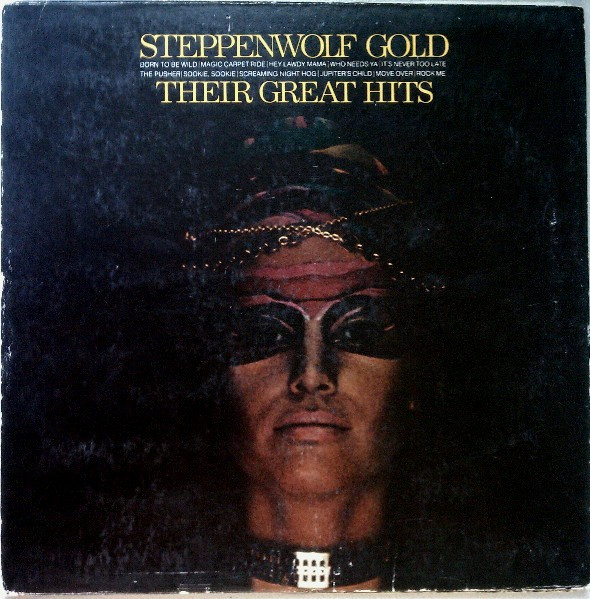
Gold (Their Great Hits)
 View on Discogs
Album Summary
Gold (Their Great Hits) came rolling out in 1971 on Dunhill Records, and it was the kind of release that felt absolutely necessary — a gathering of the thunderbolts that Steppenwolf had been hurling at the world since the late 1960s. This was a band that had been shaking walls and rattling souls from the moment they hit the scene, and this compilation brought together the essential cuts from their most explosive commercial period. Assembled while the original lineup still had fire in the tank, the album was produced in collaboration with the creative forces who had been steering the band's studio sound throughout their late-sixties run, giving the collection an authentic cohesion that felt less like a cash-in and more like a genuine statement of purpose.
Reception
- Gold (Their Great Hits) earned gold certification in the United States, a testament to how deeply Steppenwolf's catalog had burrowed into the hearts of rock audiences across the country.
- The compilation charted on the Billboard 200, carried there on the wings of the heavy radio presence that tracks like Born To Be Wild and Magic Carpet Ride had already established in the cultural consciousness.
- Critics and fans alike embraced the album as a definitive portrait of the band's most commercially vital years, and it served as a gateway for new listeners who were just discovering Steppenwolf through the relentless power of FM radio.
Significance
- This collection stood as a monument to Steppenwolf's foundational role in the development of hard rock, with tracks like Born To Be Wild and The Pusher illustrating the full range of what the band could do — from raw, thunderous energy to dark, morally unflinching storytelling.
- Gold (Their Great Hits) captured a band operating at the intersection of psychedelic rock, blues grit, and proto-heavy metal, and the album made a compelling case that Steppenwolf had been one of the architects of what hard rock would become throughout the 1970s.
- The compilation showcased the singular identity that set Steppenwolf apart — John Kay's gravelly, authoritative vocals riding over a sound built on heavy guitar riffs, swirling organ work, and lyrics that never shied away from the social and cultural tensions of their era.
Samples
- Magic Carpet Ride — one of the most recognizable tracks in the Steppenwolf catalog, it has been sampled and interpolated across multiple genres including hip-hop and electronic music, with its hypnotic groove proving irresistible to producers across decades.
- Born To Be Wild — sampled and referenced across film, television, and music productions, its iconic opening riff and the phrase that effectively coined the term 'heavy metal' have made it one of the most culturally borrowed tracks in rock history.
- The Pusher — sampled by various hip-hop artists drawn to its stark, raw energy and its unflinching narrative, the track's brooding atmosphere gave producers a sonic foundation unlike anything else in the rock canon.
Tracklist
-
A1 Born To Be Wild 144
 3:28
3:28
-
A2 It's Never Too Late 77
4:05
-
A3 Rock Me 126
3:39
-
A4 Hey Lawdy Mama —
3:00
-
A5 Move Over 133
2:53
-
A6 Who Needs Ya 116
2:59
-
B1 Magic Carpet Ride 112
4:30
-
B2 The Pusher 80
5:43
-
B3 Sookie, Sookie —
3:09
-
B4 Jupiter's Child —
3:24
-
B5 Screaming Night Hog —
3:17

Artist Details
Steppenwolf was a hard-driving rock and roll machine that came roaring out of Los Angeles in 1967, born from the bones of a Canadian band called The Sparrows, led by the gravelly-voiced John Kay who brought with him a sound that was raw, bluesy, and heavy enough to shake the walls. They helped invent what we now call hard rock and heavy metal, laying down anthems like Born to Be Wild and Magic Carpet Ride that became the sonic heartbeat of the counterculture movement, with Born to Be Wild even coining the very term "heavy metal" in its lyrics. Their music was the soundtrack of rebellion, freedom, and the open road, cementing them as one of the most culturally significant bands of the late 1960s and early 1970s, their spirit forever tied to the restless soul of a generation that refused to sit still.