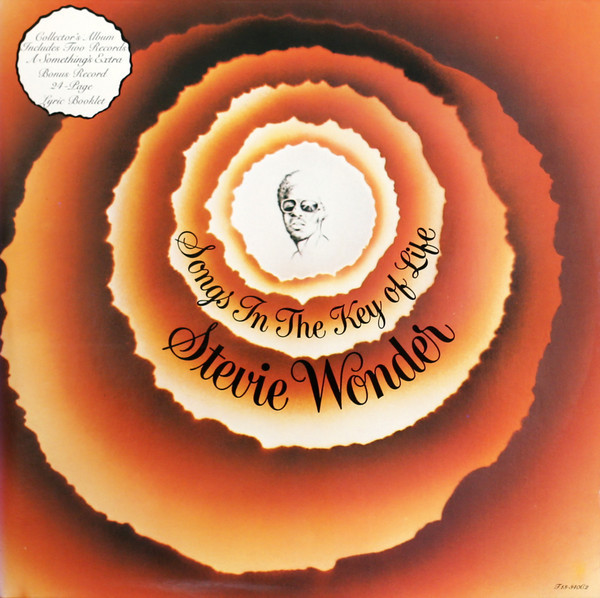
Songs In The Key Of Life
 View on Discogs
 View on Wikipedia
Album Summary
Laid down across sessions running from 1974 to 1976 at Crystal Sound, the Hit Factory, and a handful of other studios, 'Songs in the Key of Life' arrived on September 28, 1976, through Tamla/Motown Records — and baby, when it landed, it landed like nothing else that year or any year before it. Stevie Wonder self-produced every note of this sprawling two-LP set, which came packaged with a bonus four-song EP, with engineering handled by the steady hands of Gary Olazabal and a vast, deeply gifted ensemble of collaborators backing the vision. The whole project was made possible by a renegotiated Motown contract that handed Wonder a level of creative control almost unheard of in the industry at that time, and he used every inch of that freedom. These were not records made by committee or by compromise — they were the sound of a man who had been building something enormous in his mind for years, finally letting it all the way out.
Reception
- The album debuted at number one on the Billboard 200 and held that position for 14 weeks while simultaneously topping the R&B Albums chart, making it one of the most commercially dominant releases of 1976 by any measure.
- At the 1977 Grammy Awards, 'Songs in the Key of Life' took home Album of the Year, with Wonder making history as the first artist to win that award three times — a moment that felt less like a ceremony and more like a coronation.
- Both 'I Wish' and 'Sir Duke' ascended to number one on the Billboard Hot 100 as singles, extending the album's reach far beyond the album charts and proving that its ambition and its mass appeal were not in conflict.
Significance
- Few records in the history of popular music attempted what 'Songs in the Key of Life' pulled off — weaving funk, soul, jazz, classical, and gospel into a single cohesive statement that permanently widened the doorway of what a mainstream R&B album was allowed to be.
- From the street-level poetry of 'Village Ghetto Land' to the celestial joy of 'Isn't She Lovely' to the sweeping historical reckoning of 'Black Man,' the album mapped the full emotional and political landscape of Black American life with an honesty and a tenderness that gave it a cultural weight it has never lost.
- The album stands as the creative apex of a remarkable four-album run in the 1970s that redefined the relationship between an artist and their record label, proving that full artistic autonomy — when granted to a genius — could produce work of genuine and lasting consequence.
Samples
- "I Wish" — one of the most sampled grooves in hip-hop history, with its bass line and horn stabs appearing across countless records; among its most celebrated uses is Will Smith's 1998 hit 'Gettin' Jiggy Wit It.'
- "Pastime Paradise" — immortalized in the sampling canon when Coolio interpolated its chord progression and atmospheric strings for the landmark 1995 track 'Gangsta's Paradise,' one of the best-selling rap singles of all time.
- "As" — sampled by George Michael and Mary J. Blige for their 1999 duet of the same name, and revisited by numerous hip-hop producers drawn to its soaring harmonic architecture.
- "Isn't She Lovely" — one of the most recognizable melodies Wonder ever wrote, sampled and interpolated across R&B and hip-hop over multiple decades.
- "Sir Duke" — its jubilant horn riff has been sampled and replayed across hip-hop and R&B productions, a brass signature so distinct it announces itself the moment it appears in any new context.
Tracklist
-
A1 Love's In Need Of Love Today 98
 7:05
7:05
-
A2 Have A Talk With God 78
2:42
-
A3 Village Ghetto Land 92
3:25
-
A4 Contusion 129
3:45
-
A5 Sir Duke 54
3:52
-
B1 I Wish 105
4:12
-
B2 Knocks Me Off My Feet 90
3:35
-
B3 Pastime Paradise 79
3:20
-
B4 Summer Soft 104
4:16
-
B5 Ordinary Pain 97
6:22
-
C1 Isn't She Lovely —
6:33
-
C2 Joy Inside My Tears —
6:29
-
C3 Black Man —
8:29
-
D1 Ngiculela - Es Una Historia - I Am Singing —
3:48
-
D2 If It's Magic —
3:11
-
D3 As —
7:07
-
D4 Another Star —
8:19
-
E1 Saturn —
4:54
-
E2 Ebony Eyes —
4:10
-
F1 All Day Sucker —
5:06
-
F2 Easy Goin' Evening (My Mama's Call) —
3:58

Artist Details
Stevie Wonder, born Steveland Hardaway Morris in Saginaw, Michigan in 1950, came up through the soul and R&B world as a child prodigy signed to Motown Records at just eleven years old, eventually blossoming into one of the most transcendent musical geniuses this world has ever been blessed to hear — a man who weaved together soul, funk, pop, and jazz into something that felt like pure human truth. His landmark run of albums in the 1970s — Talking Book, Innervisions, Fulfillingness' First Finale, and Songs in the Key of Life — set a standard so impossibly high that even the heavens had to take notice, earning him Grammy after Grammy while simultaneously speaking to the struggles, joys, and spiritual yearning of Black America and all of humanity. Stevie Wonder didn't just make music — he made medicine for the soul, and his influence on everything that came after him in R&B, pop, and beyond is so deep and wide that you simply cannot tell the story of modern music without his name sitting right at the very center of it.