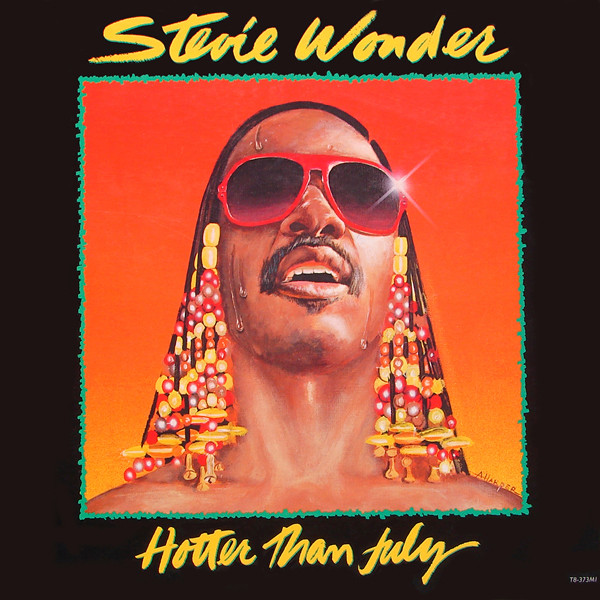
Hotter Than July
 View on Discogs
 View on Wikipedia
Album Summary
Cut at the Record Plant and Capitol Studios in Los Angeles, 'Hotter Than July' came blazing out of Motown Records in September of 1980, and Stevie Wonder — bless that man's soul — produced the whole thing himself. This was Stevie in full command, the architect of his own sound, following the extraordinary run of classic albums he had laid down in the seventies. The world was listening, and Stevie did not disappoint. He delivered something warm, righteous, and alive — a record that felt like it was made by a man who had something to say and every tool in the universe to say it with.
Reception
- The album ascended to number 3 on the Billboard 200 and claimed the top spot on the R&B Albums chart, cementing its status as one of Wonder's most commercially triumphant releases.
- It earned a Grammy Award for Best Pop Vocal Album, a testament to the craft and vision Wonder brought to every groove on this record.
- The lead single 'Master Blaster (Jammin')' rode high into the top 5 on the Billboard Hot 100, introducing a whole new generation to the magic of Stevie Wonder.
Significance
- With 'Hotter Than July,' Stevie Wonder wove together the rich threads of funk, soul, and pop with the unmistakable pulse of reggae — most gloriously in 'Master Blaster (Jammin')' — proving once again that his musical imagination respected no boundaries and feared no genre.
- 'Master Blaster (Jammin')' stood as a full-hearted, reggae-drenched celebration of Bob Marley's legacy and the enduring power of unity, broadening the reach of soul music far beyond its familiar shores and into the international conversation.
- Released at the dawn of a new decade, the album carried Stevie's unwavering commitment to socially conscious storytelling — from the joy of 'Happy Birthday,' written as a tribute to Dr. Martin Luther King Jr., to the sharp social commentary of 'Cash In Your Face' — wrapping weighty truths in grooves people could not resist.
Samples
- Master Blaster (Jammin') — one of the most widely sampled tracks in soul and hip-hop history, its infectious reggae-funk groove has been borrowed and flipped across countless recordings, standing as a cornerstone of the sampling tradition.
- All I Do — sampled across R&B and hip-hop productions, with its lush, yearning arrangement proving irresistible to producers seeking depth and warmth in their records.
- Happy Birthday — interpolated and sampled in various hip-hop and R&B contexts, its iconic melodic identity lending weight and cultural resonance to the tracks that drew from it.
- Lately — one of the album's most covered and sampled compositions, its emotional power has made it a perennial source for producers and vocalists across soul, R&B, and beyond.
- I Ain't Gonna Stand For It — sampled by hip-hop and R&B producers drawn to its bright, buoyant energy and the undeniable pocket of its rhythm track.
Tracklist
-
A1 Did I Hear You Say You Love Me 121
 4:07
4:07
-
A2 All I Do 117
5:06
-
A3 Rocket Love 77
4:40
-
A4 I Ain't Gonna Stand For It 113
4:39
-
A5 As If You Read My Mind 122
3:37
-
B1 Master Blaster (Jammin') 136
5:07
-
B2 Do Like You 122
4:26
-
B3 Cash In Your Face 96
4:01
-
B4 Lately 77
4:04
-
B5 Happy Birthday 117
5:57

Artist Details
Stevie Wonder, born Steveland Hardaway Morris in Saginaw, Michigan in 1950, came up through the soul and R&B world as a child prodigy signed to Motown Records at just eleven years old, eventually blossoming into one of the most transcendent musical geniuses this world has ever been blessed to hear — a man who weaved together soul, funk, pop, and jazz into something that felt like pure human truth. His landmark run of albums in the 1970s — Talking Book, Innervisions, Fulfillingness' First Finale, and Songs in the Key of Life — set a standard so impossibly high that even the heavens had to take notice, earning him Grammy after Grammy while simultaneously speaking to the struggles, joys, and spiritual yearning of Black America and all of humanity. Stevie Wonder didn't just make music — he made medicine for the soul, and his influence on everything that came after him in R&B, pop, and beyond is so deep and wide that you simply cannot tell the story of modern music without his name sitting right at the very center of it.