Superstition
 View on Discogs
Album Summary
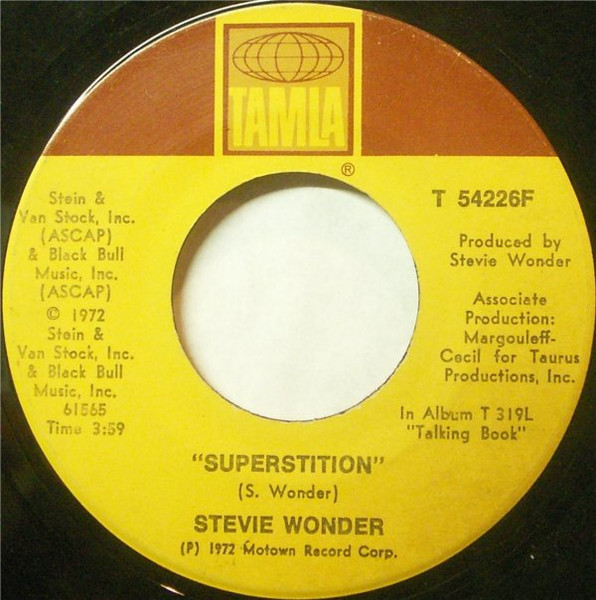
"Superstition" came into the world in 1972, dropped on the hallowed Motown Records label, and it arrived like a thunderclap from a man who was done asking permission. Stevie Wonder — barely in his twenties but already a veteran of the game — produced this record himself alongside John Fischbach, seizing the creative reins with both hands and never letting go. This release followed his groundbreaking "Music of My Mind" and found Wonder deep in that inspired stretch where he was rewriting the rules of funk and soul from the inside out, building walls of synthesizers and keyboards that sounded like nothing else on the radio in 1972. The Hohner Clavinet wasn't just an instrument in his hands — it was a weapon, and this album is the proof.
Reception
- The title track "Superstition" hit No. 1 on the Billboard Hot 100, announcing to the whole world that Stevie Wonder had entered a new and unstoppable chapter of his artistry.
- The album was embraced by both critics and the record-buying public, cementing Wonder's standing as one of the most vital forces in funk and soul music of the early 1970s.
- "Superstition" proved that Wonder could command the mainstream without compromising an inch of his artistic vision — a rare and beautiful thing.
Significance
- This album stands as a landmark moment in the evolution of funk and soul, with its revolutionary use of the Hohner Clavinet as a lead instrument reshaping what those genres could sound like.
- "Superstition" marked a defining chapter in Wonder's artistic maturation — a declaration that he was not just a hitmaker but a composer, arranger, and producer of the highest order.
- The layered synthesizer and keyboard arrangements on this record cast a long shadow over funk and R&B production for years to come, influencing countless artists who came up in its wake.
Samples
- Superstition — one of the most sampled funk records in history, with its iconic clavinet riff and groove appearing across decades of hip-hop, R&B, and pop productions by artists ranging across generations.
Tracklist
-
A Superstition 102
 4:08
4:08
-
B You've Got It Bad Girl 113
4:55

Artist Details
Stevie Wonder, born Steveland Hardaway Morris in Saginaw, Michigan in 1950, came up through the soul and R&B world as a child prodigy signed to Motown Records at just eleven years old, eventually blossoming into one of the most transcendent musical geniuses this world has ever been blessed to hear — a man who weaved together soul, funk, pop, and jazz into something that felt like pure human truth. His landmark run of albums in the 1970s — Talking Book, Innervisions, Fulfillingness' First Finale, and Songs in the Key of Life — set a standard so impossibly high that even the heavens had to take notice, earning him Grammy after Grammy while simultaneously speaking to the struggles, joys, and spiritual yearning of Black America and all of humanity. Stevie Wonder didn't just make music — he made medicine for the soul, and his influence on everything that came after him in R&B, pop, and beyond is so deep and wide that you simply cannot tell the story of modern music without his name sitting right at the very center of it.