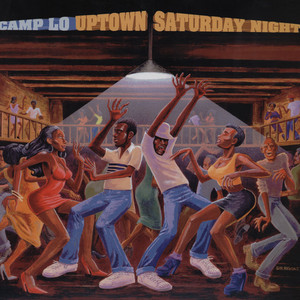
Uptown Saturday Night
 View on Discogs
 View on Wikipedia
Album Summary
Camp Lo's debut album 'Uptown Saturday Night' came rolling out of the Bronx on January 28, 1997, courtesy of Profile Records, and from the moment it hit the shelves, it was clear this was something altogether different. The duo of Sonny Cheeba and Geechi Suede linked up with producer Ski Beatz — a man with golden ears and a crate-digger's soul — to build something lush, warm, and deeply rooted in the classic funk and R&B that was already making grown folks feel good long before these two were born. Recorded during one of New York rap's most fertile creative periods, the album wore its uptown Bronx heritage proudly, channeling a swaggering, jazz-tinged street elegance that stood in beautiful contrast to the harder, more abrasive sounds that were dominating the mid-1990s hip-hop landscape at the time.
Reception
- The album arrived to strong critical embrace, with reviewers falling hard for the easy chemistry between Sonny Cheeba and Geechi Suede and the warmth of Ski Beatz's distinctive production — a combination that felt both fresh and timeless all at once.
- The lead single 'Luchini AKA This Is It' was the record that broke the door open, earning serious radio and video airplay and bringing Camp Lo to an audience that might never have found them otherwise, even as mainstream chart success stayed just out of reach.
- Though blockbuster commercial numbers never came, 'Uptown Saturday Night' grew a devoted cult following over the years and has been consistently celebrated by critics as one of the most underappreciated albums to emerge from the late-1990s New York hip-hop scene.
Significance
- 'Uptown Saturday Night' stands as a defining testament to a strain of mid-1990s New York rap that chose soul, style, and substance over crossover compromise — a record that influenced producers and MCs for years to come who heard in it a blueprint for making music with genuine vintage heart.
- Ski Beatz's work across this album elevated the art of sampling into something deeply intentional and poetic, weaving obscure soul and funk records into rich, layered soundscapes that became a touchstone in conversations about production craft in hip-hop.
- Camp Lo's thick, slang-heavy lyrical world — shot through with throwback swagger and a Harlem Renaissance-tinged cultural sensibility — gave this album a one-of-a-kind identity that no contemporary could replicate, and that singularity is precisely what secured its lasting place in the canon.
Samples
- Luchini Aka This Is It — one of the most recognized tracks from the album, with a sampling legacy that has kept it in conversations about classic 1990s hip-hop source material.
- Black Nostaljack Aka Come On — sampled and revisited by later artists drawn to its hard-knocking Ski Beatz production and the duo's commanding vocal performances.
Tracklist
-
A1 Krystal Karrington 90
 3:24
3:24
-
A2 Luchini Aka This Is It 82
3:59
-
A3 Park Joint 90
3:27
-
A4 B-Side To Hollywood 91
3:46
-
B1 Killin' Em Softly 88
3:43
-
B2 Sparkle 93
3:39
-
B3 Black Connection 84
4:06
-
B4 Swing 92
2:50
-
C1 Rockin' It Aka Spanish Harlem 89
3:36
-
C2 Say Word 95
3:13
-
C3 Negro League 91
3:23
-
C4 Nicky Barnes Aka It's Alright 96
3:13
-
D1 Black Nostaljack Aka Come On 93
4:12
-
D2 Coolie High 85
4:00
-
D3 Sparkle (Mr. Midnight Mix) 187
3:49

Artist Details
Camp Lo is a hip-hop duo out of the Bronx, New York, formed in the early 1990s by Sonny Cheeba and Geechi Suede, two cats who came up together and brought a sound so smooth and stylized it felt like jazz, blaxploitation films, and golden-era boom-bap all wrapped up in one silky package. Their 1997 debut album Uptown Saturday Night, produced by the legendary Ski Beatz, gave the world the stone-cold classic Luchini AKA This Is It, a record that had every true hip-hop head nodding their head and reaching for the replay button like it was a religious experience. Camp Lo never became household names in the mainstream, but among the cognoscenti of hip-hop culture, they remain revered figures whose slanguistic wordplay and effortlessly cool aesthetic influenced a generation of artists who understood that style and substance could walk hand in hand down the same block.