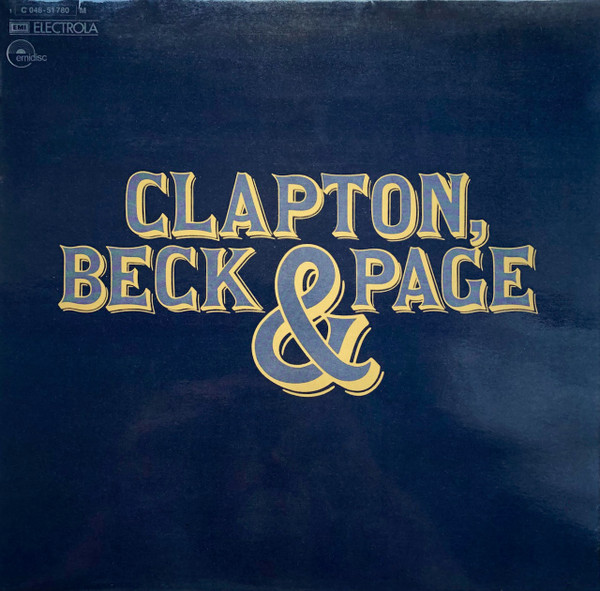
Clapton, Beck & Page
 View on Discogs
Album Summary
This 1971 release on Springboard International Records is one of those rare archival gems that pulled back the curtain on where the British blues-rock revolution was being born. Drawing from early-to-mid 1960s session recordings, this collection captures Eric Clapton alongside fellow guitar legends Jeff Beck and Jimmy Page during a period when all three were still cutting their teeth and carving their identities into the wood of the electric guitar. These tracks were largely produced and recorded in the context of studio session work and early band recordings before any of the three men became household names, making this album a document of raw, unpolished genius in its earliest and most honest form. Springboard packaged and released this material to capitalize on the massive stardom all three guitarists had achieved by the early seventies, giving the record-buying public a chance to hear the roots of something that had already changed the world.
Reception
- The album was largely viewed as a budget-label compilation release rather than an official artistic statement, and as such it received limited formal critical review upon its release.
- Among devoted fans and collectors of British blues and early rock, the record was welcomed as a rare window into the formative years of three of the era's most celebrated guitarists.
- The album did not chart in any significant or widely documented capacity, as it was distributed through budget and cutout channels rather than through major label promotional machinery.
Significance
- Tracks like 'Tribute To Elmore' and 'Freight Loader' reveal the deep Chicago and Delta blues roots that would go on to define the British blues-rock movement of the late 1960s, making this album a living document of that transatlantic musical conversation.
- The existence of this record stands as a testament to the extraordinary concentration of talent moving through London's session scene in the early-to-mid 1960s, a scene so fertile that three of rock's greatest guitarists were practically in the same room at the same time.
- Instrumentals like 'Snake Drive,' 'Miles Road,' and 'West Coast Idea' showcase a collective command of tone and phrasing that was years ahead of its time, and hearing these sides helps explain why Clapton, Beck, and Page each went on to redefine what a guitar could say and feel.
Tracklist
-
A1 Tribute To Elmore —
 2:07
2:07
-
A2 Steelin' —
2:35
-
A3 Draggin' My Tail —
3:06
-
A4 Freight Loader —
2:47
-
A5 Chuckles —
2:21
-
B1 Choker —
1:24
-
B2 L. A. Breakdown —
2:02
-
B3 Snake Drive —
2:27
-
B4 Down In The Boots —
3:22
-
B5 Miles Road —
2:21
-
B6 West Coast Idea —
2:20

Artist Details
Eric Clapton, born in Ripley, Surrey, England in 1945, emerged from the British blues explosion of the early 1960s and went on to become one of the most celebrated guitarists this world has ever had the pleasure of hearing, burning through iconic groups like the Yardbirds, John Mayall's Bluesbreakers, Cream, and Blind Faith before stepping fully into the spotlight as a solo artist. His tone — warm, crying, and deeply rooted in the Delta blues of Robert Johnson yet electric with a rock fire all his own — earned him the legendary street-corner tag "Clapton is God," and he backed that up with timeless records like *Layla*, *461 Ocean Boulevard*, and *Slowhand*. Beyond the music, Clapton stands as a bridge between American blues traditions and British rock royalty, a man who took the soul of Muddy Waters and BB King and carried it to arenas full of people who had never heard those names, keeping the blues alive and breathing for generations to come.