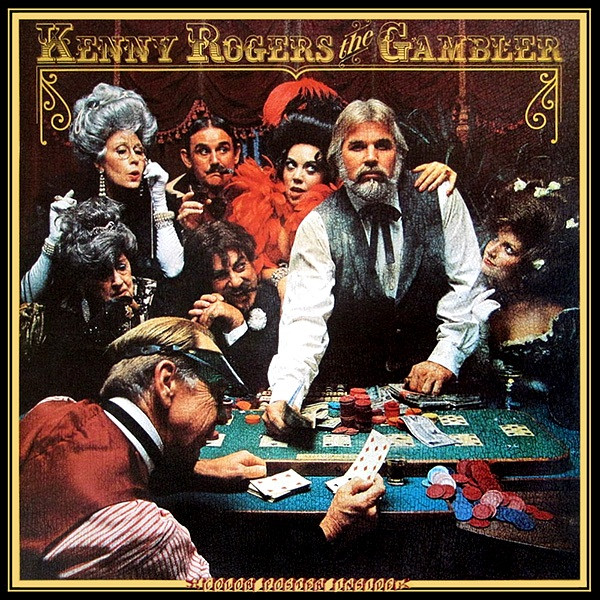
The Gambler
 View on Discogs
 View on Wikipedia
Album Summary
Kenny Rogers laid down something real special in 1978 when he stepped into the Nashville studios and cut 'The Gambler' for United Artists Records. Working alongside his trusted producer Larry Butler — a man who understood Rogers' gift for wrapping big truths in smooth, radio-ready sounds — Rogers crafted an album that rode the crest of the crossover wave he'd been building all through the late seventies. Butler's production had that signature polish, blending the warmth of traditional country with a pop accessibility that could reach a truck driver in Tulsa and a secretary in Cincinnati equally. The crown jewel of the session was 'The Gambler,' a song penned by the gifted Don Schlitz, released as a single that same year and destined to become far more than just a hit record — it became a piece of American folklore.
Reception
- The title track 'The Gambler' climbed all the way to number one on the Billboard Hot Country Singles chart and crossed over onto the pop charts, establishing itself as one of the defining country recordings of 1978.
- Kenny Rogers took home the Grammy Award for Best Male Country Vocal Performance for 'The Gambler' in 1980, a recognition that the broader music world had taken serious notice of what he and Larry Butler had built.
- Critics celebrated the album's storytelling depth, with the title track earning widespread recognition as a masterclass in narrative country songwriting — the kind of song that made people stop what they were doing and just listen.
Significance
- 'The Gambler' album was the record that locked in Kenny Rogers' standing as one of the great crossover country artists of his era, proving that Nashville storytelling could speak to mainstream pop audiences without losing its soul during a pivotal moment for the genre.
- Don Schlitz's title track introduced a philosophical, fable-driven style of songwriting to country radio that resonated so deeply it influenced generations of narrative-focused country artists who came after, showing the world that a country song could carry the weight of a short story.
- The cultural footprint of 'The Gambler' grew far beyond the grooves of this album, eventually spawning a long-running series of television movies and cementing the song as one of the most instantly recognizable pieces of American popular music ever to come out of Nashville.
Tracklist
-
A1 The Gambler 89
 3:32
3:32
-
A2 I Wish That I Could Hurt That Way Again 135
2:55
-
A3 King Of Oak Street 156
4:55
-
A4 Making Music For Money 121
3:10
-
A5 The Hoodooin' Of Miss Fannie Deberry 120
4:44
-
B1 She Believes In Me 144
4:11
-
B2 Tennessee Bottle 91
3:59
-
B3 Sleep Tight, Goodnight Man 204
2:52
-
B4 A Little More Like Me (The Crucifixion) 121
2:47
-
B5 San Francisco Mabel Joy —
3:36
-
B6 Morgana Jones 146
3:03

Artist Details
Kenny Rogers, born in Houston, Texas in 1938, came up through the jazz and rock worlds before finding his true calling as one of the defining voices of country-pop crossover music, first making waves with the New Christy Minstrels and The First Edition before launching a solo career in the late 1970s that turned him into an absolute juggernaut. With that warm, weathered baritone wrapping around story-songs like The Gambler, Lucille, and Lady, Rogers had a gift for spinning a narrative that could pull at the heartstrings of a truck driver and a suburban housewife all at the same time, making him one of the best-selling artists of his era with over 165 million records sold worldwide. He stands as a cornerstone of the countrypolitan sound, a man who helped tear down the walls between Nashville and pop radio and proved that a good story told with soul could move mountains — and chart positions.