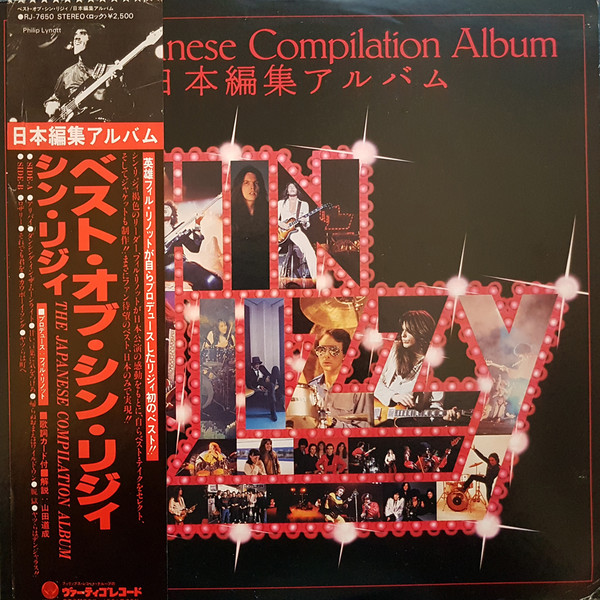
The Japanese Compilation Album
 View on Discogs
Album Summary
Thin Lizzy's 'The Japanese Compilation Album' came roaring out of Vertigo Records in 1980, a lovingly assembled package put together specifically for the Japanese market — and honey, that market was hungry for it. This was a time when Western rock labels knew that Japanese fans weren't just casual listeners; they were devoted, they were serious, and they deserved something special. Drawing from the band's most potent mid-to-late 1970s recordings, produced across sessions helmed by the likes of Tony Visconti and John Alcock, the album gave Japanese audiences a concentrated dose of Phil Lynott's soul-drenched songwriting and that unmistakable twin-guitar thunder that Scott Gorham and Brian Robertson — and later Gary Moore — had helped forge into one of rock's most distinctive sounds. Half the album blazes through studio classics, and the other half lets those live tracks breathe fire, because if there was one thing Thin Lizzy knew how to do, it was own a stage.
Reception
- As a Japan-exclusive regional release, the album did not chart or receive formal critical review in the Western music press, with its reception contained almost entirely within the Japanese market and among dedicated import collectors abroad.
- The compilation drew on Thin Lizzy's already formidable reputation in Japan, where the band's hard-driving sound and Phil Lynott's charismatic presence had earned them a deeply loyal following, ensuring the album was warmly embraced upon release.
- In retrospective music journalism, the album has received minimal critical attention, regarded more as a curated commercial offering for a specific regional audience than as a standalone artistic statement in the band's catalog.
Significance
- This album stands as a vivid artifact of the Japan-only compilation trend that defined major label strategy in the late 1970s and early 1980s, when labels recognized that Asian markets — particularly Japan — warranted their own carefully tailored product rather than simple imports.
- For Thin Lizzy, the release documented the band's remarkable international commercial reach at a genuinely turbulent moment in their history, a period when internal pressures and lineup instability were quietly beginning to cast a shadow over what had been one of rock's most electrifying runs.
- The pairing of studio cuts with live recordings on this compilation captures the full breadth of what made Thin Lizzy so compelling across cultural boundaries — the Celtic soul, the blues grit, the twin-guitar interplay — and reminds the world that Phil Lynott's vision was always bigger than any one geography could contain.
Samples
- The Boys Are Back In Town" — one of the most recognizable rock anthems of the 1970s and among the most sampled and interpolated Thin Lizzy recordings, with notable uses across hip-hop and pop productions over the decades.
- Jailbreak" — sampled and interpolated by various artists drawn to its hard-driving riff and outlaw energy, lending it a secondary life beyond its classic rock origins.
- Cowboy Song (Live)" — the live version's groove and rhythmic foundation have attracted attention from producers mining rock catalog for sample material.
Tracklist
-
A1 Waiting For An Alibi 148
 3:30
3:30
-
A2 Dancing In The Moonlight —
3:27
-
A3 Don't Believe A Word 144
2:17
-
A4 Wild One 119
4:18
-
A5 Jailbreak 145
4:02
-
A6 Do Anything You Want To 154
3:54
-
B1 Rosalie (Live) —
4:03
-
B2 Still In Love With You (Live) —
7:44
-
B3 Cowboy Song (Live) —
4:53
-
B4 The Boys Are Back In Town (Live) —
4:43

Artist Details
Thin Lizzy was a hard rock powerhouse that rolled out of Dublin, Ireland in 1969, led by the magnetic and soulful Phil Lynott, a Black Irish frontman whose deep groove sensibility gave the band a rhythm and blues heartbeat beneath all that electric thunder — and honey, nobody was doing it quite like that. They carved their name in rock history with that signature twin-guitar attack, pioneered by Scott Gorham and Brian Robertson, laying down anthems like The Boys Are Back in Town and Jailbreak that hit the airwaves in the mid-seventies like a freight train wrapped in silk. Thin Lizzy proved to the whole world that hard rock could have swagger, soul, and poetry all at once, and their influence can be heard echoing through decades of rock and roll that came long after their final bow.