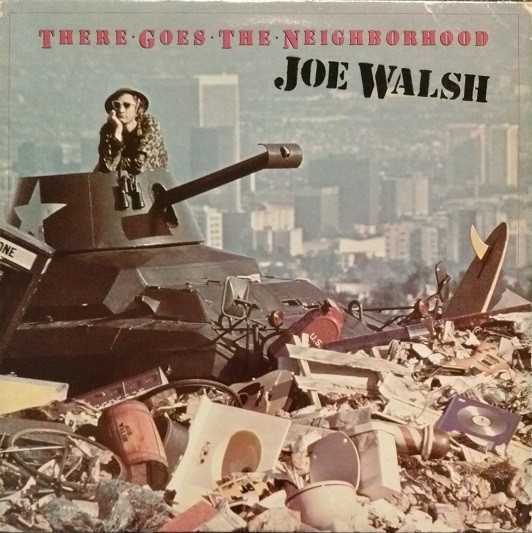
There Goes The Neighborhood
 View on Discogs
Album Summary
There Goes the Neighborhood came rolling out of the studio in 1981 on Asylum Records, and brother, it arrived at a crossroads moment for Joe Walsh — a man who had already proven himself a stone-cold guitar legend with the James Gang, a celebrated solo run, and those golden years riding shotgun with the Eagles. Walsh stepped into the producer's chair himself, sharing duties with the late great Mick Ronson — yes, that Mick Ronson, Bowie's right-hand axeman — and that pairing alone tells you something special was being attempted here. The sessions were aimed at capturing a harder, more muscular rock sound, something that would plant Walsh's flag firmly in the new decade while honoring the blues-soaked instincts that made him a hero to guitarists everywhere. It was a man in motion, searching for his footing on shifting ground.
Reception
- A Life of Illusion emerged as the album's shining moment on the airwaves, becoming one of Walsh's most recognized solo tracks of the early 1980s and earning substantial radio play across rock stations nationwide.
- The album climbed to number 31 on the Billboard 200, a respectable showing but a step back from the commercial heights Walsh had scaled with his late-1970s work.
- Critical response landed somewhere in the middle of the road — reviewers tipped their hats to Walsh's undeniable guitar craft and vocal charm while raising an eyebrow or two at some uneven moments in the songwriting and production.
Significance
- There Goes the Neighborhood stands as a genuine artifact of the arena rock era, capturing that moment when the raw, road-worn spirit of 1970s rock started brushing up against the sleeker, synthesizer-touched production values that would come to define the 1980s mainstream.
- The record reflects the broader cultural and sonic shift happening across rock music in 1981, documenting how even the most celebrated artists of the previous decade were wrestling with questions of identity and reinvention as the landscape changed beneath their feet.
- Walsh's guitar work throughout the album — particularly the muscular interplay of blues instinct and hard rock drive — reaffirms his standing as one of rock's most distinctive and soulful six-string voices, even as the commercial winds were blowing in new directions.
Tracklist
-
A1 Things 86
 5:36
5:36
-
A2 Made Your Mind Up 115
4:24
-
A3 Down On The Farm 78
3:11
-
A4 Rivers (Of The Hidden Funk) 98
5:03
-
B1 A Life Of Illusion 123
3:30
-
B2 Bones 120
4:32
-
B3 Rockets 92
3:51
-
B4 You Never Know 123
5:20

Artist Details
Joe Walsh is one of those rare cats who could melt your face off with a guitar riff one moment and make you feel like you were cruising down a sunset highway the next — born in Wichita, Kansas in 1947, he first made his mark tearing up the Cleveland rock scene with the James Gang in the late '60s before going solo and eventually joining the Eagles in 1975, bringing that raw, gritty edge to one of the biggest bands on the planet. His sound blended hard rock thunder with that laid-back California groove, and his solo classics like Rocky Mountain Way and Life's Been Good proved he was just as massive on his own as he was carrying the weight of any supergroup. Walsh became a living symbol of that golden era where rock and roll was still dangerous and beautiful at the same time, influencing generations of guitarists and cementing himself as one of the true unsung heroes of American rock history.