Physical Graffiti
 View on Discogs
 View on Wikipedia
Album Summary
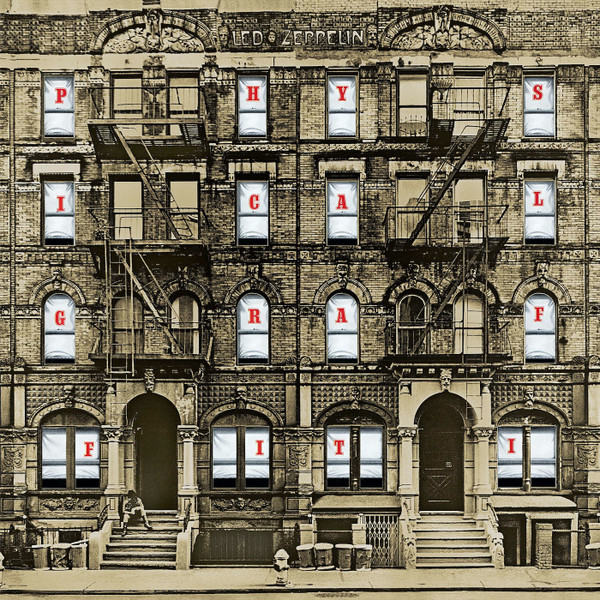
Led Zeppelin's sixth studio album, Physical Graffiti was laid down across 1974 at various locations — including the storied Headley Grange in Hampshire, where the band had conjured magic before — and came roaring into the world on February 20, 1975, through Swan Song Records, the band's own imprint riding distribution through Atlantic. Produced by the visionary Jimmy Page alongside the band themselves, this magnificent double album arrived in one of the most celebrated sleeves in rock history: a gatefold designed to evoke the facade of a New York City tenement building, complete with die-cut windows that let the inner sleeves peek through like souls looking out from another world. It was more than a record — it was an event, a statement, a monument, and the moment it hit the shelves, the world knew Led Zeppelin had delivered something that would outlast them all.
Reception
- Debuted at number one on the Billboard 200 and went on to earn multi-platinum certification across numerous countries, cementing its place among the best-selling albums of all time.
- Received widespread critical acclaim upon release and has been consistently enshrined by critics and major publications as one of the greatest rock albums ever committed to vinyl.
- Its release created such seismic commercial demand that every previous Led Zeppelin album simultaneously re-entered the Billboard charts — a rare and staggering phenomenon that spoke to the band's total dominance of the era.
Significance
- Physical Graffiti stands as a towering testament to the peak of hard rock in the 1970s, weaving together blues, folk, Eastern mysticism, and earth-shaking heavy instrumentation into a double-album tapestry that no band before or since has quite replicated.
- The album showcases Led Zeppelin's breathtaking genre versatility in full bloom — from the delicate acoustic reverie of Bron-Yr-Aur to the thunderous swagger of Custard Pie to the vast, cinematic Eastern odyssey of Kashmir, all living together on the same four sides of wax without a single moment of contradiction.
- Its ambitious scope and production philosophy shaped the sound and aesthetic of arena rock and heavy metal for the remainder of the decade and well into the next, leaving fingerprints on generations of rock and metal musicians who heard in its grooves a blueprint for thinking bigger, deeper, and louder.
Samples
- Trampled Under Foot — one of the most sampled tracks from this album, its churning rhythmic groove has been lifted by numerous hip-hop and funk-influenced artists across decades.
- Custard Pie — sampled by Jay-Z and Timbaland on the track Kashmir from the 2001 film soundtrack for Timbaland's production work, and has a noted history of reuse in hip-hop productions drawing on its opening riff and rhythm.
- Kashmir — among the most recognizable and revisited compositions in rock, its hypnotic ostinato has been sampled and interpolated widely, most famously by Puff Daddy featuring Jimmy Page on Come With Me from the 1998 Godzilla soundtrack.
- Boogie With Stu — its rolling piano-driven groove has attracted attention from producers mining the Physical Graffiti sessions for raw rhythmic material.
- Sick Again — referenced and sampled within hard rock and hip-hop contexts drawn to its aggressive opening riff and groove.
Tracklist
-
A1 Custard Pie 92
 4:20
4:20
-
A2 The Rover 103
5:54
-
A3 In My Time Of Dying 101
11:08
-
B1 Houses Of The Holy 123
4:01
-
B2 Trampled Under Foot 112
5:38
-
B3 Kashmir 80
9:41
-
C1 In The Light 127
8:46
-
C2 Bron-Yr-Aur 171
2:07
-
C3 Down By The Seaside 92
5:15
-
C4 Ten Years Gone 76
6:55
-
D1 Night Flight 103
3:37
-
D2 The Wanton Song 112
4:10
-
D3 Boogie With Stu 136
3:45
-
D4 Black Country Woman 129
4:30
-
D5 Sick Again 112
4:40

Artist Details
Oh baby, let me tell you about Led Zeppelin, the mighty thunder gods of rock who rose up out of London, England in 1968, forged from the ashes of the Yardbirds when guitarist Jimmy Page recruited Robert Plant, John Bonham, and John Paul Jones to create one of the most electrifying sounds the world had ever witnessed — a raw, blues-drenched, hard rock hurricane that laid the very foundation for heavy metal and stadium rock as we know it. From "Whole Lotta Love" to "Stairway to Heaven," these cats pushed the boundaries of what rock and roll could be, blending folk, Eastern mysticism, and thunderous riffs into an epic sonic tapestry that sold over 300 million records worldwide and made them one of the best-selling music artists of all time. Culturally, Led Zeppelin didn't just make music, sugar — they reshaped the entire landscape of rock, inspiring generations of musicians and cementing their legacy as one of the greatest and most influential bands to ever grace this beautiful, funky Earth.