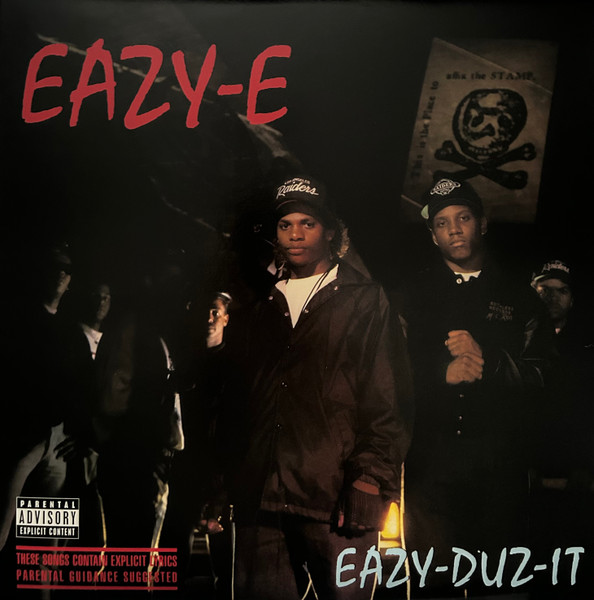
Eazy-Duz-It
 View on Discogs
 View on Wikipedia
Album Summary
Eazy-Duz-It came roaring out of Compton on September 16, 1988, dropped through Ruthless Records and Priority Records — and baby, when that record hit the streets, the game was never quite the same again. Eazy-E's debut solo studio album was laid down at recording facilities in Torrance, California, with the production reins held firmly in the hands of Dr. Dre and DJ Yella, his brothers-in-arms from N.W.A, with Arabian Prince stepping in to add his own flavor to the mix. What they captured on tape was something raw and alive — Eazy's unmistakable high-pitched voice riding hard over funk-drenched beats, carving out a solo identity that was distinctly his own, even as it grew from the same fertile soil that was producing N.W.A's most explosive work. This was independent hip-hop operating at the highest level, built not on major label machinery but on hustle, vision, and an unshakable sense of place.
Reception
- The album proved that gangsta rap could move serious units without radio support or major label backing, eventually earning double platinum certification from the RIAA — a commercial triumph that made the industry sit up and take notice.
- Eazy-E's unfiltered, street-level storytelling and sharp comedic edge resonated deeply with fans who heard something authentic in his voice, though the album's graphic content drew fierce controversy from parent groups and political figures who saw it as a threat to the moral order.
- Eazy-Duz-It climbed to number 41 on the Billboard 200 and reached number 9 on the Top R&B/Hip-Hop Albums chart — extraordinary numbers for an independent release operating with virtually none of the traditional promotional infrastructure that the majors took for granted.
Significance
- Eazy-Duz-It stands as one of the cornerstone documents of West Coast gangsta rap, a record that helped pull hip-hop's cultural center of gravity westward from New York to Los Angeles and put Compton on the map as a symbol of hardcore rap that resonated around the entire world.
- The production work of Dr. Dre and DJ Yella on this album — thick with funk and R&B samples, layered and purposeful — helped define the sonic DNA of late-1980s West Coast hip-hop and established a sample-driven aesthetic that would become the signature sound of Ruthless Records.
- As one of the earliest and most successful releases on Ruthless Records, the album demonstrated with undeniable clarity that independent hip-hop labels could thrive outside the major label system, laying down a business model that inspired generations of rap imprints to follow their own path.
Samples
- Boyz-N-The Hood (Remix) — one of the most recognized tracks in the West Coast gangsta rap canon, with a notable sampling history reflecting its status as a foundational street anthem of the Ruthless Records era.
- Eazy-Duz-It — the title track has been sampled by various artists paying homage to Eazy-E's legacy and the classic Dre and Yella production style that defined the album.
- We Want Eazy — sampled by artists drawn to its energetic call-and-response structure and its place as one of the most crowd-ready moments in early West Coast hip-hop.
Tracklist
-
A1 (Prelude) —

-
A2 Still Talkin' —
3:48
-
A3 Nobody Move —
-
A4 2 Hard Mutha's —
4:26
-
A5 Boyz-N-The Hood (Remix) —
-
A6 Eazy-Duz-It —
4:20
-
B1 We Want Eazy —
5:02
-
B2 Eazy-Er Said Than Dunn —
-
B3 Radio —
-
B4 No More?'s —
-
B5 I'mma Break It Down —
3:28
-
B6 Eazy - Chapter 8 Verse 10 (B.U.L.L.S.H.I.T.) —

Artist Details
Eazy-E, born Eric Lynn Wright in Compton, California, was the real-deal street poet who co-founded N.W.A and helped launch Ruthless Records in the mid-1980s, bringing a raw, unfiltered West Coast gangsta rap sound that hit the music world like a freight train. His gritty delivery and unflinching storytelling on tracks like "Boyz-n-the-Hood" didn't just push boundaries — it ripped them clean off, paving the way for an entire generation of West Coast hip-hop artists and forcing the music industry to reckon with the realities of inner-city life. Eazy-E's legacy, though tragically cut short by his passing in 1995 from AIDS-related complications, remains a cornerstone of hip-hop history, and his influence continues to echo through the culture like a bassline that never fades.