3 Feet High And Rising
 View on Discogs
 View on Wikipedia
Album Summary
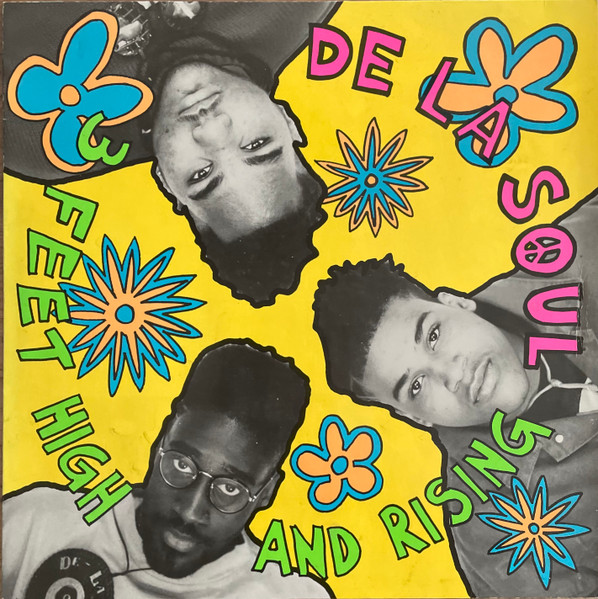
Back in 1989, three young cats from Amityville, Long Island — Posdnuos, Dave Jolicoeur, and Maseo — walked into the studio and changed the whole game without anybody fully realizing it yet. De La Soul recorded '3 Feet High And Rising' with producer Prince Paul at the helm, a man who had a gift for stitching together sonic collages that felt like a fever dream at a backyard cookout. Released on Tommy Boy Records in March of 1989, this debut album was born out of pure creative freedom and youthful audacity — these brothers weren't trying to sound hard, they weren't chasing what was hot on the block, they were building their own world and inviting you to step inside it. Prince Paul's production gave the record a kaleidoscopic, playful texture, wrapping the whole thing in game show skits and left-field humor that made it feel less like a hip-hop album and more like a joyful art project that happened to have the hardest beats you ever heard.
Reception
- Upon its release, '3 Feet High And Rising' was met with near-universal critical acclaim, with music publications hailing it as a breath of fresh air in a hip-hop landscape that was rapidly hardening in tone and aesthetic.
- The album performed strongly on the charts, reaching the top 25 on the Billboard 200 and climbing high on the R&B/Hip-Hop charts, earning De La Soul a mainstream commercial foothold without ever compromising their vision.
- Tracks like 'Me Myself And I' and 'Eye Know' crossed over to broader audiences and received significant radio and MTV airplay, establishing De La Soul as genuine stars rather than just a cult curiosity.
Significance
- This album is widely credited as the founding document of the Native Tongues movement, a loose collective of artists who pushed hip-hop toward Afrocentric positivity, abstract lyricism, and a deliberately offbeat sensibility that stood in beautiful contrast to the aggression dominating the era.
- '3 Feet High And Rising' shattered the notion that hip-hop had to present a singular, street-hardened identity — De La Soul's embrace of the so-called 'D.A.I.S.Y. Age' philosophy proved that Black joy, nerdiness, and vulnerability were not weaknesses but revolutionary acts in and of themselves.
- The album's bold use of skits, interludes, and theatrical framing as structural elements of the listening experience was genuinely ahead of its time, setting a template for how hip-hop albums could function as immersive, cinematic works rather than simple collections of songs.
Samples
- "Me Myself And I" — one of the most recognizable vocal hooks in late-80s hip-hop, this track has been sampled and interpolated across multiple genres, with its swaggering self-affirmation proving irresistible to producers for decades after its release.
- "The Magic Number" — built around a groove so infectious it practically begged to be lifted, this track has been sampled by numerous artists and remains one of the most beloved touchstones from the album's rich sonic palette.
- "Potholes In My Lawn" — the rolling, chunky production on this track made it a favorite source material for producers looking for that warm, textured late-80s boom-bap foundation.
- "Say No Go" — this track's deeply soulful melodic core has drawn the attention of producers and artists seeking to borrow its emotional warmth and groove-heavy construction.
- "Eye Know" — built on layers of classic soul, this track's joyful sonic architecture has been revisited and repurposed by artists drawn to its undeniable warmth and feel-good energy.
Tracklist
-
A1 Intro 92
 1:41
1:41
-
A2 The Magic Number 120
3:14
-
A3 Change In Speak 91
2:32
-
A4 Cool Breeze On The Rocks 137
0:37
-
A5 Can U Keep A Secret? —
1:40
-
A6 Jenifa Taught Me (Derwin's Revenge) 118
3:23
-
A7 Ghetto Thang 95
3:34
-
A8 Transmitting Live From Mars 90
1:11
-
A9 Eye Know 109
4:12
-
A10 Take It Off 67
1:52
-
A11 A Little Bit Of Soap 137
0:49
-
A12 Tread Water 100
3:44
-
A13 Potholes In My Lawn 93
3:47
-
B1 Say No Go 112
4:19
-
B2 Do As De La Does 96
2:06
-
B3 Plug Tunin' (Last Chance To Comprehend) 93
4:06
-
B4 Da La Orgee —
1:12
-
B5 Buddy 200
4:54
-
B6 Description 46
1:30
-
B7 Me Myself And I 112
3:40
-
B8 This Is A Recording 4 Living In A Full Time Era (L.I.F.E.) —
3:09
-
B9 I Can Do Anything (Delacratic) 105
0:40
-
B10 D.A.I.S.Y. Age 142
3:55

Artist Details
De La Soul is an American hip-hop trio formed in Amityville, New York, in 1987, consisting of Posdnuos (Kelvin Mercer), Trugoy the Dove (David Jolicoeur), and Maseo (Vincent Mason). Emerging during the golden age of hip-hop, they distinguished themselves from their peers with a playful, eclectic sound that blended jazz, funk, and soul samples with witty, introspective, and often abstract lyricism, rejecting the harder-edged styles popular at the time. Their 1989 debut album 3 Feet High and Rising is widely regarded as a landmark record in hip-hop history, pioneering what became known as the alternative hip-hop movement and earning praise for its innovative use of sampling and unconventional song structures. As founding members of the Native Tongues collective alongside A Tribe Called Quest and the Jungle Brothers, De La Soul helped shape a more Afrocentric, positive, and creative strand of hip-hop that influenced countless artists across multiple generations. Their legacy was further cemented in 2023 when their long-out-of-print catalog was finally made available on streaming platforms, introducing their groundbreaking work to a new generation of listeners, though the group suffered a profound loss with the passing of Trugoy the Dove in February of that same