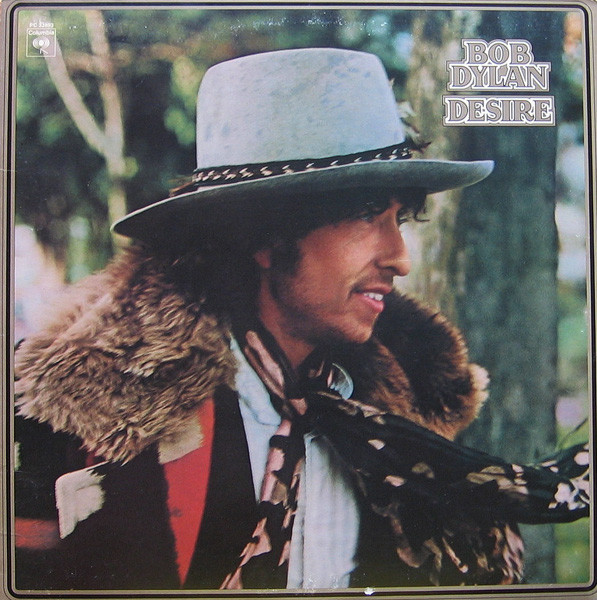
Desire
 View on Discogs
 View on Wikipedia
Album Summary
Recorded in late July 1975 at Columbia Recording Studios in New York City, 'Desire' was produced by Don DeVito and released by Columbia Records on January 16, 1976. Most tracks were captured in single takes across just a few blazing sessions — the kind of raw, inspired energy that doesn't come along but once in a great while. Dylan brought in violinist Scarlet Rivera, a woman he reportedly spotted walking down a New York street and simply knew she belonged on this record, and her presence would prove to be one of the most inspired decisions of his entire career. Playwright Jacques Levy co-wrote the majority of the album's tracks, lending the songs a dramatic, literary sweep that felt entirely new. The whole record grew from the same restless, searching spirit that was driving Dylan's Rolling Thunder Revue tour across the land at that very same time.
Reception
- The album debuted at number one on the Billboard 200 chart and held that position for five weeks, standing as one of the most commercially successful records of Dylan's storied career.
- The single 'Hurricane,' a fierce and righteous protest song about the wrongful imprisonment of boxer Rubin 'Hurricane' Carter, earned heavy radio airplay and reached number 33 on the Billboard Hot 100 — a remarkable achievement for a track running nearly nine minutes long.
- Critics embraced the album's bold storytelling ambition and its rich, eclectic weave of folk, country, and world music influences, recognizing it as a powerful and fully realized creative statement from an artist at the height of his powers.
Significance
- 'Desire' stands as a landmark achievement in narrative songwriting, with its long-form ballads — 'Hurricane' and 'Joey' among them — proving that pop music could hold cinematic, character-driven stories of genuine depth and moral weight.
- Scarlet Rivera's soaring, gypsy-tinged violin work gave the album a sound unlike anything else in Dylan's catalog, a distinctly otherworldly folk texture that left a lasting imprint on the Americana and folk-rock genres for years to come.
- The political fire of 'Hurricane' carried real-world consequence, helping to focus national attention on Rubin Carter's case and reaffirming — right in the heart of the mid-1970s mainstream — that a song could still shake something loose in the conscience of a nation.
Tracklist
-
A1 Hurricane 135
 8:33
8:33
-
A2 Isis 147
6:58
-
A3 Mozambique 127
3:00
-
A4 One More Cup Of Coffee 69
3:43
-
A5 Oh, Sister 123
4:05
-
B1 Joey 116
11:05
-
B2 Romance In Durango 168
5:50
-
B3 Black Diamond Bay 97
7:30
-
B4 Sara 152
5:29

Artist Details
Bob Dylan, born Robert Zimmerman in Duluth, Minnesota in 1941, rose out of the Greenwich Village folk scene in the early 1960s to become nothing less than the conscience of a generation, blending folk, blues, and rock with a poet's soul and a prophet's fire. His albums like *Freewheelin'* and *Highway 61 Revisited* didn't just make you feel something — they made you *think* something, challenging the very notion of what a pop song could be and cementing his place as the first true singer-songwriter in the modern sense. Dylan's influence runs so deep through rock, folk, and beyond that it's nearly impossible to imagine the musical landscape without him — the man literally won the Nobel Prize in Literature, and every serious artist who ever picked up a pen owes him at least a quiet nod of thanks.