The Freewheelin' Bob Dylan
 View on Discogs
 View on Wikipedia
Album Summary
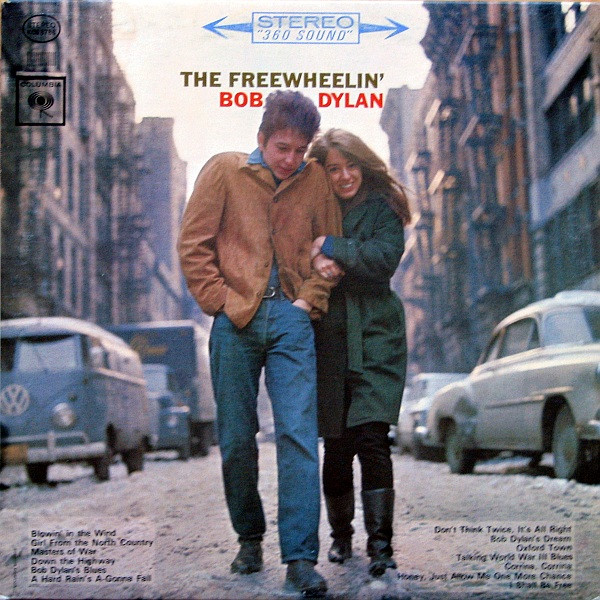
Recorded primarily in the fall of 1962 at Columbia Recording Studios in New York City, 'The Freewheelin' Bob Dylan' was the young poet's second long-player for Columbia Records, produced by the legendary John Hammond — the man who had the ears to sign Dylan in the first place. Released on May 27, 1963, this was the record where Bobby Dylan stopped being a promising folk kid and became a voice for a generation. Where his debut leaned heavy on traditional covers, 'Freewheelin'' was something else entirely — a collection almost entirely of original compositions, written by a twenty-one-year-old with the wisdom of an old soul and the fire of a man who had something urgent to say. Columbia let this young lion roam, and what came out of those sessions was nothing short of a revelation — protest, love, humor, and prophecy all wrapped up in one glorious, ramshackle package.
Reception
- The album was not an immediate commercial blockbuster upon release, but it built a devoted and passionate following through word of mouth, particularly among the college crowd and the Greenwich Village folk scene, which was already buzzing about Dylan like he was the second coming of Woody Guthrie.
- Critical reception in the folk press was rapturous from the start, with reviewers marveling at the sheer volume and sophistication of original songwriting from someone so young — 'Blowin' In The Wind' and 'A Hard Rain's A-Gonna Fall' in particular drew widespread awe from critics who recognized they were hearing something historic.
- The album gained significant commercial traction in the United Kingdom, where it charted strongly and helped establish Dylan as a major transatlantic figure, laying the groundwork for the British Invasion artists who would soon cite him as a towering influence.
Significance
- 'The Freewheelin' Bob Dylan' is widely regarded as one of the foundational documents of the protest song movement of the 1960s — tracks like 'Blowin' In The Wind,' 'Masters Of War,' and 'A Hard Rain's A-Gonna Fall' didn't just reflect the anxieties of the nuclear age and the civil rights struggle, they helped shape the moral vocabulary of an entire generation of activists and musicians.
- This album marked a seismic shift in the folk tradition itself, proving that the form could carry the weight of original, literary songwriting rather than relying solely on the transmission of traditional material — Dylan essentially opened a door that changed what popular music believed it was allowed to say and how it was allowed to say it.
- The album stands as one of the great early testaments to the singer-songwriter as artist and auteur — every track on 'Freewheelin'' bears the unmistakable stamp of one young man's imagination, humor, heartbreak, and fury, establishing a template for personal and political expression in popular music that reverberates to this very day.
Samples
- Blowin' In The Wind — one of the most referenced and interpolated songs in popular music history, with its melody and lyrics drawn upon across genres including soul, hip-hop, and R&B by artists paying homage to its anthem status.
- Don't Think Twice, It's All Right — sampled and interpolated by various artists across decades, with its guitar figure and lyrical framework drawing particular attention from hip-hop producers seeking its melancholic folk texture.
Tracklist
-
A1 Blowin' In The Wind 87

-
A2 Girl From The North Country 118
3:20
-
A3 Masters Of War 166
-
A4 Down The Highway 137
-
A5 Bob Dylan's Blues 124
-
A6 A Hard Rain's A-Gonna Fall —
-
B1 Don't Think Twice, It's All Right 110
-
B2 Bob Dylan's Dream 109
-
B3 Oxford Town 106
-
B4 Talking World War III Blues —
-
B5 Corrina, Corrina 95
-
B6 Honey, Just Allow Me One More Chance 119
-
B7 I Shall Be Free 100

Artist Details
Bob Dylan, born Robert Zimmerman in Duluth, Minnesota in 1941, rose out of the Greenwich Village folk scene in the early 1960s to become nothing less than the conscience of a generation, blending folk, blues, and rock with a poet's soul and a prophet's fire. His albums like *Freewheelin'* and *Highway 61 Revisited* didn't just make you feel something — they made you *think* something, challenging the very notion of what a pop song could be and cementing his place as the first true singer-songwriter in the modern sense. Dylan's influence runs so deep through rock, folk, and beyond that it's nearly impossible to imagine the musical landscape without him — the man literally won the Nobel Prize in Literature, and every serious artist who ever picked up a pen owes him at least a quiet nod of thanks.