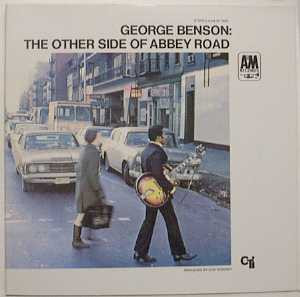
The Other Side Of Abbey Road
 View on Discogs
Album Summary
Recorded in 1969 and released in 1970 on CTI Records — that groundbreaking label Creed Taylor built into a jazz powerhouse — 'The Other Side of Abbey Road' was produced by Creed Taylor himself and finds George Benson doing something nobody else had the nerve or the chops to attempt: taking the entire second side of the Beatles' 'Abbey Road' medley and reimagining it through the lens of jazz guitar virtuosity. Benson brought along a crew of serious heavyweights including Herbie Hancock on keyboards, Ron Carter on bass, and Billy Cobham on drums, turning Abbey Road's familiar corridors into something altogether hipper and more soulful. CTI's signature lush production style — rich, warm, and detailed — gave the record a polished sheen that set it apart from both the British rock original and the straight-ahead jazz of the day.
Reception
- The album found a warm welcome among jazz audiences who appreciated Benson's audacity and technique, helping to establish him as one of the most inventive guitarists of his generation at a time when fusion and crossover were reshaping the genre.
- Critics marveled at how naturally the Beatles' songwriting translated into a jazz context, with particular praise heaped on Benson's ability to honor the melodic integrity of the source material while making every note unmistakably his own.
- While it didn't chart in the blockbuster commercial sense, the album built Benson's reputation steadily and contributed to CTI Records' growing prestige as the home of jazz that could reach across to a wider, more diverse audience.
Significance
- This album stands as one of the earliest and most fully realized jazz interpretations of Beatles material, arriving just as the Fab Four were disbanding and proving that their songwriting legacy was deep enough to sustain serious instrumental reimagining.
- The record helped define the CTI Records sound and aesthetic — lush orchestration meeting elite jazz improvisation — and served as a blueprint for the kind of crossover jazz that would flourish throughout the 1970s.
- By tackling the Abbey Road medley as a continuous suite rather than cherry-picking individual hits, Benson and Taylor made a bold artistic statement about the structural sophistication of rock composition and jazz's capacity to elevate and transform it.
Samples
- Here Comes The Sun — Benson's luminous guitar interpretation of this Harrison classic has been revisited and sampled by various producers drawn to its warm, melodic jazz guitar tone as a foundation for soul and neo-soul productions.
Tracklist
-
A1 Golden Slumbers —
 2:35
2:35
-
A2 You Never Give Me Your Money 95
3:07
-
A3 Because / Come Together —
7:35
-
A4 Oh! Darling 96
3:55
-
B1 Here Comes The Sun —
2:25
-
B2 I Want You (She's So Heavy) 88
6:20
-
B3 Something / Octopus's Garden 118
4:30
-
B4 The End —
1:55

Artist Details
George Benson is a silky-smooth guitarist and vocalist out of Pittsburgh, Pennsylvania, who came up through the jazz trenches in the 1960s before blowing the roof off the mainstream in 1976 with his landmark album Breezin, a record so gorgeous it crossed every boundary between jazz, soul, and pop and made the whole world sit down and listen. That album went platinum and made Benson the first jazz artist to have a number one R&B and pop album simultaneously, proving that serious musicianship and commercial appeal could walk hand in hand without either one losing its dignity. His velvet voice and dazzling fretwork built a bridge between the jazz elite and everyday music lovers, cementing his legacy as one of the most complete and beloved artists of his generation.