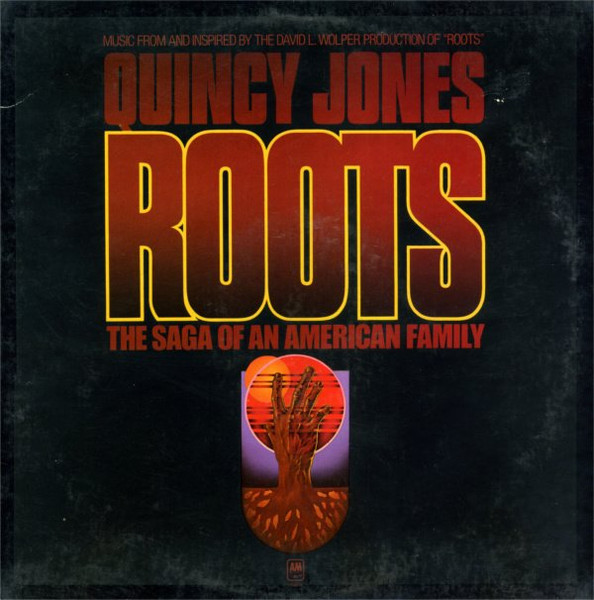
Roots (The Saga Of An American Family)
 View on Discogs
Album Summary
When Quincy Jones sat down to score the television event of a generation, he knew he wasn't just writing music — he was bearing witness. Released on A&M Records in 1977, 'Roots: The Saga of an American Family' stands as one of the most emotionally charged soundtrack albums ever committed to wax. Jones, already a titan of orchestral arranging and jazz production, brought every ounce of his genius to bear on ABC's landmark miniseries adaptation of Alex Haley's Pulitzer Prize-winning novel. Drawing on authentic African instrumentation, deep-rooted spirituals, and sweeping symphonic orchestration, Jones crafted a score that didn't just accompany the story of an African-American family's odyssey from the shores of West Africa through the brutality of slavery and into the promise of emancipation — it breathed life into it. This was sacred work, and the music knows it.
Reception
- The album earned Quincy Jones a Grammy Award for Best Album of Original Score Written for a Motion Picture or Television Special in 1978, a testament to the overwhelming power and craft of his work on this project.
- The 'Roots' miniseries drew over 130 million viewers and became one of the most-watched television events in American broadcast history, amplifying the reach and cultural footprint of Jones's accompanying score.
- Critics celebrated Jones's masterful fusion of authentic African musical textures with Western orchestration, recognizing the score's rare ability to honor historical truth while delivering profound emotional resonance.
Significance
- This score stands as one of the first major American television soundtracks to weave authentic African instrumentation and rhythmic structures into the fabric of mainstream media, giving African musical heritage a platform it had long deserved on the American cultural stage.
- Jones's work on 'Roots' redefined what television music could do — tracks like 'Oluwa (Many Rains Ago)' and 'Middle Passage (Slaveship Crossing)' demonstrated that a television score could carry the full weight of historical trauma and spiritual resilience with the same gravity as any concert hall composition.
- The album remains a milestone at the crossroads of popular music production and socially conscious storytelling, reflecting the broader cultural reckoning with America's history that the 'Roots' miniseries ignited in the late 1970s and whose echoes are still felt today.
Tracklist
-
A1 Motherland —
 0:29
0:29
-
A2 Roots Mural Theme —
2:10
-
A3 Main Title: Mama Aifambeni (Premiere Episode) —
1:03
-
A4 Behold, The Only Thing Greater Than Yourself (Birth) —
1:30
-
A5 Oluwa (Many Rains Ago) (African Theme) —
2:28
-
A6 Boyhood To Manhood —
0:53
-
A7 The Toubob Is Here! (The Capture) —
1:06
-
A8 Middle Passage (Slaveship Crossing) —
1:15
-
A9 You In Americuh' Now, African —
0:32
-
B1 Roots Mural Theme Intro (Slave Auction) —
0:15
-
B2 Ole Fiddler —
1:12
-
B3 Jumpin' De Broom (Marriage Ceremony) —
0:42
-
B4 What Can I Do? (Hush, Hush, Somebody's Calling My Name) —
2:17
-
B5 Roots Mural Theme Bridge (Plantation Life) —
1:25
-
B6 Oh Lord, Come By Here —
3:25
-
B7 Free At Last? (The Civil War) —
2:24
-
B8 Many Rains Ago (Oluwa) (African Theme: English Version) —
4:50

Artist Details
Quincy Jones is a one-of-a-kind genius out of Chicago, Illinois, a man who has been blessing our ears since the 1950s as a composer, arranger, producer, and bandleader whose fingerprints are all over jazz, soul, R&B, and pop like nobody else in the game. He came up under the wing of Ray Charles, went on to arrange for the great Count Basie and Frank Sinatra, and then turned around and produced some of the biggest records in history — including Michael Jackson's *Off The Wall* and *Thriller* — cementing himself as the architect behind sounds that moved millions of souls across generations. Quincy Jones didn't just make music; he built bridges between genres, between races, and between eras, standing tall as living proof that true artistry knows no boundaries and never goes out of style.