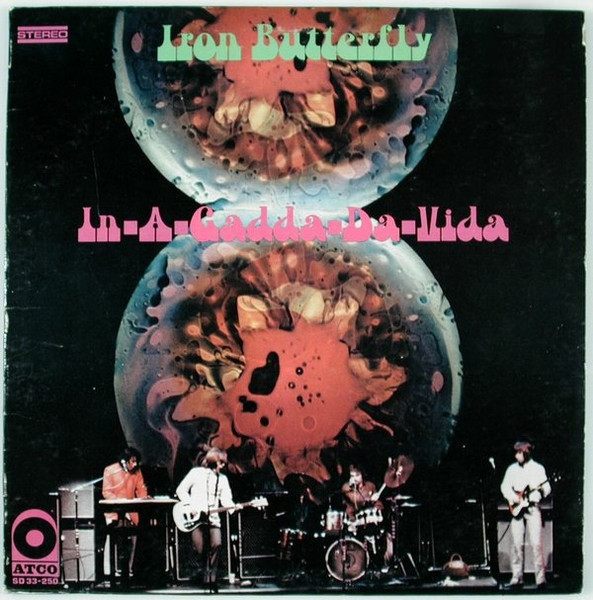
In-A-Gadda-Da-Vida
 View on Discogs
 View on Wikipedia
Album Summary
In-A-Gadda-Da-Vida was laid down and released in 1968 on Atco Records — a subsidiary of Atlantic — marking Iron Butterfly's second studio offering and the one that would burn their name into rock history forever. Produced by the band themselves alongside engineer Jim Hilton, this record captured something raw and alive, something that studio trickery couldn't manufacture and committee thinking couldn't have designed. The band was riding a wave of heavy, organ-drenched psychedelia, and when they walked into the studio, they brought that whole brooding, hypnotic energy with them. What came out the other side was a record that felt less like a polished product and more like a living, breathing thing — side one a collection of shorter psych-rock gems, and side two devoted entirely to one monumental title track that would rewrite the rules of what a rock song could even be.
Reception
- The album ascended to number four on the Billboard 200, becoming one of the highest-charting and best-selling rock albums of the entire decade — a commercial force that simply could not be ignored.
- The seventeen-minute-plus title track became an FM radio phenomenon, proving that album-oriented radio had an appetite for something deeper and longer than the standard three-minute pop single.
- Critical response at the time was split down the middle — some ears heard genius in the repetition and instrumental depth, while others called it excess — but the record-buying public rendered their own unanimous verdict at the cash register.
Significance
- In-A-Gadda-Da-Vida stands as a foundational stone in the architecture of heavy psychedelic rock and proto-metal, with Doug Ingle's Hammond organ roaring alongside heavy guitar in a way that pointed toward everything hard rock would become in the decade ahead.
- The side-long title track helped establish the legitimacy of the extended rock composition, planting seeds that would bloom into the entire progressive rock movement of the 1970s — bands like Yes, ELP, and Deep Purple all owe something to what Iron Butterfly dared to put on wax here.
- The album demonstrated with undeniable commercial evidence that rock music could stretch beyond pop conventions and still connect with a mass audience, fundamentally changing the relationship between album-oriented artists and the radio landscape.
Samples
- In-A-Gadda-Da-Vida — one of the most recognized and sampled riffs in rock history, with its iconic drum solo and bass line appearing across decades of hip-hop and electronic music productions.
Tracklist
-
A1 Most Anything You Want —
 3:41
3:41
-
A2 Flowers And Beads —
3:05
-
A3 My Mirage —
4:51
-
A4 Termination —
2:50
-
A5 Are You Happy —
4:28
-
B In-A-Gadda-Da-Vida —
17:05

Artist Details
Iron Butterfly was a heavy psychedelic rock outfit that came together in San Diego, California back in 1966, cooking up a thick, churning sound that blended blues-soaked organ grooves with hard-driving guitar in a way that made the earth shake beneath your feet. These cats laid the groundwork for heavy metal and progressive rock long before those labels even existed, and their 1968 epic "In-A-Gadda-Da-Vida" — clocking in at seventeen glorious minutes — became one of the best-selling albums of its era and proved that rock music could be a deep, sprawling, transcendent experience. Iron Butterfly may not always get the full credit they deserve, but any serious student of rock history knows that without them, the heavier, more adventurous sounds of the seventies simply don't happen the same way.