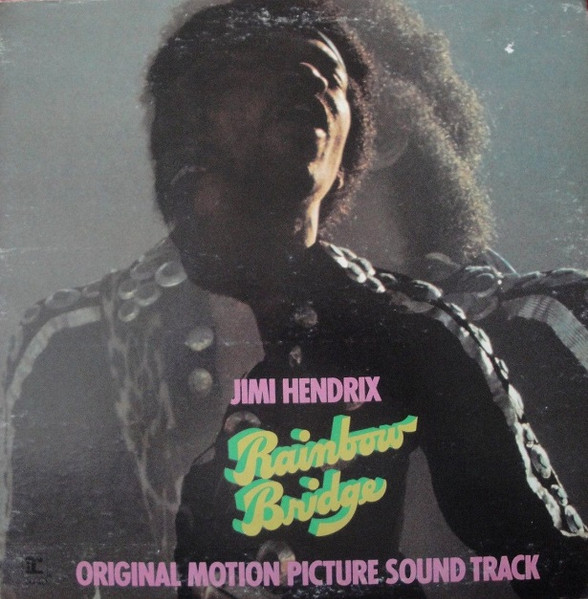
Rainbow Bridge / Original Motion Picture Sound Track
 View on Discogs
Album Summary
Rainbow Bridge — the Original Motion Picture Soundtrack — came together from sessions Jimi Hendrix recorded between 1968 and 1969, capturing that restless genius at his most exploratory. Released in October 1971 on Reprise Records, nearly a full year after Hendrix left this world, the album was produced to accompany Chuck Wein's loose, dreamlike documentary film of the same name. Engineer Eddie Kramer, who knew Hendrix's sonic universe better than just about anyone alive, shaped the audio with the care and reverence the material deserved. The recordings pull from studio sessions and live performances, stitched together into something that feels less like a conventional soundtrack and more like a séance — Hendrix reaching across the veil with his guitar still blazing.
Reception
- The album reached number 15 on the Billboard 200, a strong showing that confirmed the world's hunger for every last note Hendrix had left behind.
- Critical reception was divided — some heard a visionary collection of late-period genius, while others felt the material lacked the cohesion of Hendrix's finest studio work.
- Its connection to Wein's unconventional, countercultural film gave Rainbow Bridge a cult mystique that kept it alive in the conversations of serious Hendrix devotees long after its release.
Significance
- Rainbow Bridge stands as a testament to Hendrix's relentless artistic evolution, documenting his push beyond psychedelic rock and deeper into blues, funk, and experimental sonic territory that was pointing toward a future he never got to fully inhabit.
- The album preserves a crucial transitional moment in one of rock's greatest careers, offering alternate takes and unreleased studio work that pull back the curtain on a creative process that was perpetually in motion, never satisfied, always reaching.
- As a soundtrack record, Rainbow Bridge reflects Hendrix's genuine openness to cross-media collaboration, lending his singular musical voice to a visual and cinematic project at a time when the boundaries between rock music and avant-garde film were thrillingly blurred.
Tracklist
-
A1 Dolly Dagger 121
 4:45
4:45
-
A2 Earth Blues 110
4:20
-
A3 Pali Gap 103
5:05
-
A4 Room Full Of Mirrors 143
3:17
-
A5 Star Spangled Banner 109
4:07
-
B1 Look Over Yonder 137
3:28
-
B2 Hear My Train A Comin' 84
11:15
-
B3 Hey Baby (New Rising Sun) 81
6:05

Artist Details
Jimi Hendrix, born in Seattle, Washington in 1942, was a singular force of nature who burst onto the international scene in the mid-1960s, blending blues, rock, and psychedelia into something so electric and otherworldly that the music world has never quite caught its breath since. His guitar work — raw, transcendent, and technically revolutionary — redefined what the instrument could say and do, making classics like Purple Haze, Voodoo Child, and his immortal rendition of The Star-Spangled Banner at Woodstock in 1969 into permanent chapters of American musical scripture. Tragically gone at just 27 in 1970, Hendrix left behind a legacy so towering that every guitarist who picked up a six-string after him had to reckon with his shadow, and his influence stretches across rock, funk, jazz, and soul like a beautiful, unending sonic earthquake.